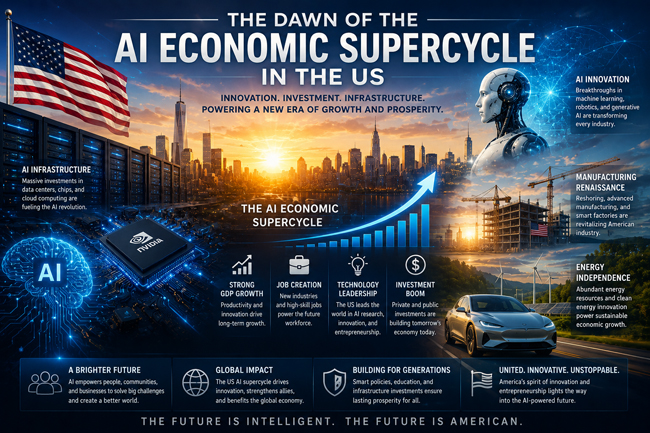
The United States economy is on the cusp of a transformative era, driven by the rapid advancement and widespread adoption of Artificial Intelligence (AI). This phenomenon, often referred to as the “AI Economic Supercycle,” is poised to redefine economic growth, productivity, and market dynamics for years to come. Unlike previous technological revolutions, AI’s impact is expected to be more profound and pervasive, touching nearly every sector and aspect of economic activity.
Understanding the AI Economic Supercycle
An economic supercycle is a prolonged period of sustained economic expansion, typically lasting several decades, driven by fundamental technological or structural shifts. These cycles are characterized by accelerated productivity growth, increased investment, and the emergence of new industries. The AI Economic Supercycle represents the latest iteration of this phenomenon, with AI technology acting as the primary catalyst.
Key Drivers of the AI Supercycle
Several factors are converging to fuel this AI-driven economic boom:
-
Exponential Growth in Computing Power: Moore’s Law, though debated, has seen computing power increase dramatically, enabling the development of complex AI models.
-
Big Data Availability: The proliferation of digital data provides the essential fuel for training and refining AI algorithms.
-
Algorithmic Advancements: Breakthroughs in machine learning, deep learning, and neural networks have made AI capabilities more sophisticated and versatile.
-
Increased Investment: Venture capital, corporate R&D, and government funding are pouring into AI research and development, accelerating innovation.
AI’s Transformative Impact Across Sectors
The AI Economic Supercycle is not confined to the tech industry. Its influence is spreading across diverse sectors:
1. Productivity Enhancement and Automation
AI is automating repetitive tasks, optimizing complex processes, and enabling new levels of efficiency. This translates to significant productivity gains across manufacturing, logistics, customer service, and administrative functions. For example, AI-powered robots in manufacturing can work with greater precision and speed, while AI in customer service can handle a higher volume of inquiries more effectively.
2. Innovation and New Business Models
AI is a powerful engine for innovation, enabling the creation of entirely new products, services, and business models. From personalized medicine and autonomous vehicles to advanced financial analytics and hyper-personalized marketing, AI is opening up uncharted territories for economic growth. Companies that leverage AI effectively are gaining a competitive edge by offering novel solutions and superior customer experiences.
3. Data-Driven Decision Making
AI’s ability to analyze vast amounts of data and extract actionable insights is revolutionizing decision-making processes. Businesses can now make more informed strategic choices, identify emerging market trends, and mitigate risks with greater accuracy. This data-driven approach enhances operational efficiency and strategic agility.
4. The Future of Work and Skill Development
The AI supercycle will inevitably reshape the labor market. While some jobs may be automated, new roles requiring AI-related skills, creativity, and critical thinking will emerge. This necessitates a focus on reskilling and upskilling the workforce to adapt to the evolving demands of the AI-powered economy. Lifelong learning will become paramount.
Challenges and Considerations
Despite the immense potential, the AI Economic Supercycle also presents challenges:
-
Ethical Concerns: Issues surrounding data privacy, algorithmic bias, and job displacement require careful consideration and robust regulatory frameworks.
-
Digital Divide: Ensuring equitable access to AI technologies and the skills needed to utilize them is crucial to prevent widening societal inequalities.
-
Cybersecurity Risks: As economies become more reliant on AI systems, the potential for cyberattacks and data breaches increases, demanding enhanced security measures.
-
Regulatory Landscape: Governments worldwide are grappling with how to regulate AI effectively without stifling innovation, a delicate balancing act.
Investing in the AI Supercycle
For investors, the AI Economic Supercycle presents significant opportunities. Identifying companies at the forefront of AI development, adoption, and application can yield substantial returns. This includes:
-
AI Chip Manufacturers: Companies developing the foundational hardware for AI.
-
Software and Platform Providers: Businesses creating AI algorithms, tools, and cloud infrastructure.
-
AI-Enabled Companies: Businesses across various sectors that are successfully integrating AI to gain competitive advantages.
-
Robotics and Automation Firms: Companies at the forefront of physical and digital automation.
However, it’s crucial to approach AI investments with a long-term perspective, understanding the inherent risks and the rapid pace of technological change. Diversification and thorough due diligence are essential.
Preparing for the AI-Driven Future
Individuals and businesses alike must proactively prepare for the AI Economic Supercycle:
-
Embrace Lifelong Learning: Continuously acquire new skills, particularly those related to AI, data science, and digital literacy.
-
Foster Adaptability: Cultivate a mindset that embraces change and is open to new ways of working and problem-solving.
-
Invest in AI Literacy: Understand the basic principles of AI and its potential applications in your field.
-
Encourage Ethical AI Development: Advocate for responsible AI practices that prioritize fairness, transparency, and human well-being.
The AI Economic Supercycle: A New Era of Growth
The AI Economic Supercycle is not merely a technological trend; it is a fundamental shift that will redefine the global economic landscape. The United States, with its robust innovation ecosystem and significant investment in AI, is well-positioned to lead this transformation. By understanding its drivers, embracing its opportunities, and addressing its challenges, we can navigate this new era of unprecedented growth and prosperity. The future is intelligent, and the AI Economic Supercycle is its harbinger.
Conclusion
The AI Economic Supercycle marks a pivotal moment for the US economy. It promises enhanced productivity, groundbreaking innovation, and new avenues for growth. However, realizing this potential requires proactive adaptation, continuous learning, and responsible development.
-
Action 1: Invest in upskilling and reskilling your workforce to meet the demands of an AI-driven economy.
-
Action 2: Explore how AI can be integrated into your business operations to improve efficiency and create new value.
-
Action 3: Stay informed about AI advancements and ethical considerations to navigate this evolving landscape effectively.