
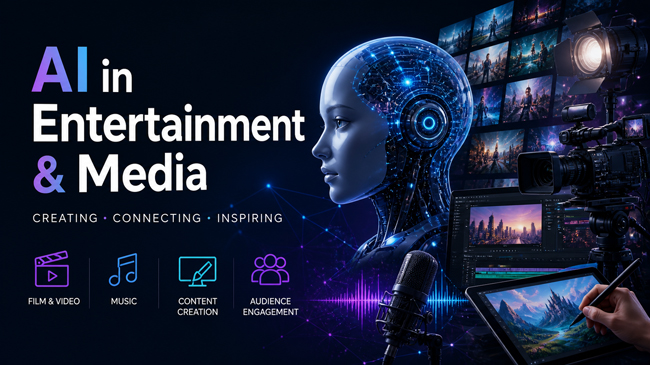
The AI Revolution in Entertainment and Media
Artificial intelligence (AI) is no longer a futuristic concept; it’s a present-day force reshaping industries, and entertainment and media are at the forefront of this transformation. From the way content is created to how we discover and consume it, AI is introducing unprecedented levels of efficiency, personalization, and innovation. This article delves into the multifaceted role of AI in the entertainment and media landscape, exploring its current applications, the benefits it brings, and the exciting future it promises.
Understanding AI’s Role: More Than Just Algorithms
At its core, AI in entertainment and media refers to the use of intelligent systems that can perform tasks typically requiring human intelligence. This includes learning, problem-solving, decision-making, and understanding complex data. In this context, AI leverages vast amounts of data – from viewing habits and user preferences to script analysis and market trends – to drive sophisticated operations.
AI in Content Creation: From Script to Screen
One of the most profound impacts of AI is on the very creation of entertainment content.
Scriptwriting and Story Development
AI tools are now capable of assisting in scriptwriting. By analyzing successful scripts, AI can identify narrative structures, character archetypes, and dialogue patterns that resonate with audiences. While AI isn’t yet writing award-winning screenplays independently, it serves as a powerful co-writer, generating ideas, suggesting plot twists, and even helping to refine dialogue for better flow and impact. This can significantly speed up the pre-production process and overcome writer’s block.
Visual Effects (VFX) and Animation
The creation of stunning visual effects and lifelike animations is notoriously labor-intensive. AI is revolutionizing this by automating repetitive tasks, such as rotoscoping (isolating moving objects frame by frame) and motion tracking. AI algorithms can also generate realistic textures, animate complex character movements, and even create entirely new digital assets, reducing both the time and cost associated with VFX production. For instance, AI can be used to de-age actors or create digital doubles with remarkable accuracy.
Music Composition and Sound Design
AI is also making inroads into music creation. Algorithms can now compose original music in various genres, generate background scores for films and games, and even create unique sound effects. These tools can help composers explore new sonic territories and provide a vast library of royalty-free music for content creators.
AI in Content Personalization and Recommendation
Perhaps the most visible application of AI for the average consumer is in personalized content recommendation. Streaming platforms like Netflix, Spotify, and YouTube have mastered this art.
The Power of Recommendation Engines
These platforms use AI-powered recommendation engines that analyze an individual’s viewing history, ratings, search queries, and even the time of day they watch content. Based on this data, AI predicts what else you might enjoy, curating personalized playlists, movie suggestions, and news feeds. This not only enhances user engagement but also helps users discover content they might otherwise miss.
Tailoring User Experience
Beyond recommendations, AI can dynamically adjust the user interface and content delivery based on individual preferences. This could include adjusting video quality, recommending content in a preferred language, or even personalizing advertisements.
AI in Audience Engagement and Marketing
AI plays a crucial role in understanding and engaging with audiences, both before and after content is released.
Sentiment Analysis and Market Research
AI can analyze social media conversations, reviews, and forum discussions to gauge audience sentiment towards a particular movie, show, or artist. This real-time feedback helps studios and distributors understand what’s working, what’s not, and how to tailor their marketing strategies.
Targeted Advertising and Campaign Optimization
AI algorithms enable highly targeted advertising campaigns. By segmenting audiences based on demographics, interests, and online behavior, AI ensures that marketing messages reach the most receptive viewers. This not only improves the effectiveness of advertising spend but also reduces ad fatigue for consumers.
Virtual Assistants and Chatbots
AI-powered virtual assistants and chatbots are increasingly used to interact with customers, answer frequently asked questions, provide support, and even facilitate ticket bookings or merchandise purchases. This offers a more immediate and personalized customer service experience.
AI in Broadcasting and Live Events
AI is also transforming the way live content is produced and delivered.
Automated Production and Editing
In sports broadcasting, AI can automatically identify key moments, such as goals or touchdowns, and generate highlight reels in real-time. AI can also assist in camera control, switching between different angles to capture the most exciting action.
Enhancing Live Experiences
For live events, AI can be used to personalize the viewing experience, offering different camera feeds or statistical overlays based on viewer preferences. It can also help in crowd management and safety by analyzing crowd density and movement patterns.
The Benefits of AI in Entertainment and Media
The integration of AI brings a multitude of advantages:
- Increased Efficiency: Automating repetitive tasks frees up human creatives to focus on higher-level conceptual work.
- Enhanced Personalization: Delivering content and experiences tailored to individual tastes leads to greater user satisfaction and loyalty.
- Cost Reduction: Streamlining production processes and optimizing marketing spend can lead to significant cost savings.
- Deeper Audience Insights: AI provides unparalleled data analysis capabilities, offering a comprehensive understanding of audience behavior and preferences.
- New Creative Possibilities: AI tools can unlock novel ways of creating and experiencing content, pushing the boundaries of artistic expression.
Challenges and Ethical Considerations
Despite its immense potential, the widespread adoption of AI in entertainment and media also presents challenges:
- Job Displacement: Automation could lead to job losses in certain sectors, requiring workforce retraining and adaptation.
- Bias in Algorithms: AI systems are trained on data, and if that data contains biases, the AI can perpetuate or even amplify them, leading to unfair or discriminatory outcomes in content creation or recommendation.
- Copyright and Ownership: Determining ownership and copyright for AI-generated content is a complex legal and ethical issue that is still being debated.
- The “Black Box” Problem: Understanding exactly how some complex AI algorithms arrive at their decisions can be difficult, raising concerns about transparency and accountability.
- Maintaining Authenticity and Human Touch: There’s a concern that over-reliance on AI could lead to a homogenization of content or a loss of the unique human creativity and emotional depth that audiences crave.
The Future of AI in Entertainment and Media
The trajectory of AI in this sector is one of continued innovation and deeper integration. We can anticipate:
- More sophisticated AI-powered content generation tools: Expect AI to become even more capable in creating scripts, music, and even visual elements.
- Hyper-personalized interactive experiences: AI will likely enable more immersive and interactive entertainment, where content adapts in real-time to user input and emotional responses.
- AI-driven virtual and augmented reality: AI will be essential for creating believable and responsive virtual environments and characters in XR content.
- Predictive analytics for content success: AI will become even more adept at predicting which content will be successful, influencing investment decisions.
- Ethical AI frameworks: As AI becomes more powerful, there will be a greater focus on developing and implementing ethical guidelines to ensure responsible use.
Conclusion: Embracing the AI-Powered Future
AI is not just a tool but a transformative partner in the entertainment and media industries. It’s enhancing creativity, refining delivery, and forging deeper connections with audiences. While challenges related to ethics, jobs, and authenticity need careful consideration, the potential for AI to enrich our entertainment experiences is undeniable. By understanding and strategically embracing AI, content creators, distributors, and consumers alike can navigate and thrive in this exciting new era of entertainment.
Frequently Asked Questions (FAQ)
Q1: Can AI completely replace human creativity in entertainment?
A1: While AI can assist and even generate creative elements, it’s unlikely to fully replace human creativity. The unique emotional intelligence, life experiences, and nuanced understanding that human creators bring are currently irreplaceable for producing deeply resonant and authentic content. AI is best viewed as a powerful tool to augment human creativity.
Q2: How does AI personalize my streaming recommendations?
A2: AI recommendation engines analyze your past behavior (what you watch, rate, search for), compare it to the behavior of millions of other users with similar tastes, and identify patterns. Based on these patterns, it predicts other content you are likely to enjoy and presents it to you.
Q3: What are the biggest ethical concerns with AI in media?
A3: Key ethical concerns include potential job displacement due to automation, the perpetuation of biases present in training data, issues around copyright and ownership of AI-generated content, and a lack of transparency in how certain AI decisions are made. Ensuring fairness, accountability, and human oversight are critical.