
The Enigmatic Glow: Unpacking Lunar Impact Flashes
The Moon, often perceived as a silent, unchanging celestial body, harbors a hidden dynamism. One of the most captivating phenomena observed on its surface is the lunar impact flash – a fleeting, yet brilliant, burst of light. These flashes, though ephemeral, are providing scientists with a treasure trove of information, particularly through the lens of NASA’s ambitious Artemis program.
What Exactly Are Lunar Impact Flashes?
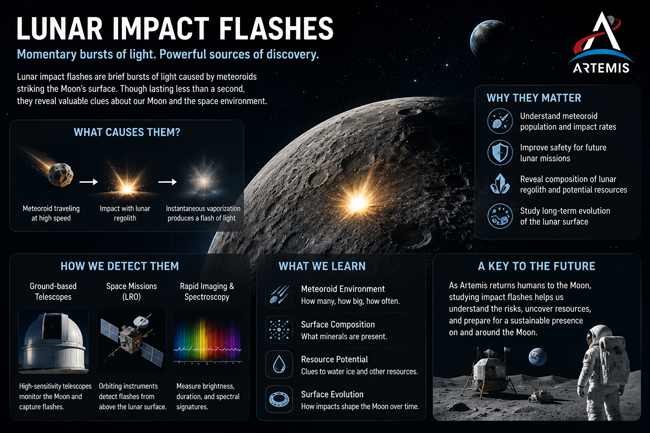
At their core, lunar impact flashes are precisely what their name suggests: brief flashes of light originating from the Moon’s surface. These events are not caused by volcanic activity or any internal lunar processes. Instead, they are the direct result of small meteoroids, ranging in size from that of a grain of sand to a small pebble, colliding with the lunar surface at incredibly high speeds.
When these tiny cosmic projectiles strike the Moon, they possess immense kinetic energy. This energy is rapidly converted into heat and light upon impact. The intense heat causes the lunar soil, known as regolith, to vaporize and glow incandescently for a fraction of a second. The brighter the flash, the larger and faster the impacting meteoroid. These flashes are typically only visible to sensitive instruments and, under very specific and dark conditions, can sometimes be glimpsed by the human eye.
The Science Behind the Spark: Why Do They Happen?
The physics governing lunar impact flashes are rooted in the principles of kinetic energy and material science. A meteoroid traveling through space carries a significant amount of kinetic energy, calculated by the formula KE = 1/2 * mv^2, where ‘m’ is the mass of the meteoroid and ‘v’ is its velocity. Even small objects can possess substantial kinetic energy if their velocity is high enough.
When this high-velocity object encounters the lunar regolith, it undergoes a rapid deceleration. This sudden stop generates an enormous amount of heat through friction and compression. The regolith at the impact site is instantaneously heated to thousands of degrees Celsius, causing it to glow. The specific color and intensity of the flash can provide clues about the composition of both the meteoroid and the lunar surface it strikes. For instance, impacts in areas rich in certain minerals might produce flashes with distinct spectral signatures.
The duration of these flashes is incredibly short, typically lasting less than a second, and often only a few hundredths of a second. This brevity makes them challenging to detect and study, requiring sophisticated equipment and precise timing.
NASA’s Artemis Program: Illuminating the Moon
The Artemis program, NASA’s initiative to return humans to the Moon and establish a sustainable lunar presence, has placed a significant emphasis on understanding the lunar environment. A key component of this understanding involves studying lunar impact flashes. The Artemis missions are equipped with advanced instruments designed to detect and analyze these transient events.
One of the primary goals of studying these flashes is to better characterize the population of meteoroids that are constantly bombarding the Moon. By observing the frequency and intensity of these impacts, scientists can estimate the rate at which the Moon is being struck by objects of various sizes. This information is crucial for several reasons.
Firstly, it helps in understanding the long-term evolution of the lunar surface. The continuous bombardment by meteoroids shapes the lunar landscape over geological timescales, creating craters and altering the regolith. Secondly, knowing the meteoroid flux is vital for ensuring the safety of future lunar missions. Astronauts and equipment on the lunar surface could be at risk from larger, though rarer, impacts.
Furthermore, the analysis of impact flashes provides valuable data about the composition of the lunar regolith. Different materials within the regolith will react differently to the energy of an impact, producing distinct light signatures. By studying these signatures, scientists can map out the mineralogical composition of the lunar surface with greater detail than ever before. This is particularly important for identifying potential resources, such as water ice, that could be utilized by future lunar inhabitants.
The Instruments of Discovery: How We Detect Them
Detecting lunar impact flashes is a sophisticated endeavor. Ground-based telescopes, particularly those with high sensitivity and rapid imaging capabilities, play a crucial role. NASA has deployed specialized observatories and instruments to monitor the Moon for these events.
One notable example is the Lunar Reconnaissance Orbiter (LRO), which carries instruments capable of detecting these flashes from orbit. However, for detailed analysis and understanding of the impact process, ground-based observations are often preferred. These observations allow for higher resolution data and the ability to correlate flashes with specific impact locations.
The process typically involves continuous monitoring of the lunar surface. When a flash is detected, astronomers record its location, brightness, duration, and spectral characteristics. This data is then meticulously analyzed to infer properties of the impacting object and the lunar material. The challenge lies in distinguishing these faint flashes from background noise and other transient phenomena. Advanced algorithms and data processing techniques are employed to ensure the accuracy of the detections.
Beyond the Flash: What We Learn from These Events
The study of lunar impact flashes extends far beyond simply observing a fleeting light. The data gathered offers profound insights into several aspects of lunar science:
Understanding Lunar Regolith Dynamics
The lunar regolith is a complex and dynamic layer of dust and broken rock that covers the Moon’s surface. Impacts constantly churn and mix this material. By studying the flashes, scientists can gain a better understanding of how energy is transferred during impacts and how this influences the physical properties of the regolith. This is critical for designing equipment that can operate effectively on the lunar surface, such as rovers and construction machinery.
Estimating Meteoroid Flux and Size Distribution
The frequency of impact flashes directly correlates with the rate at which meteoroids are striking the Moon. By analyzing a large number of flashes over time, astronomers can build statistical models of the meteoroid flux – the number of objects of a certain size passing through a given area per unit of time. This information is not only relevant to the Moon but also to Earth, as many meteoroids that strike the Moon would likely also reach our own planet if not for Earth’s atmosphere.
Mapping Lunar Composition and Resources
As mentioned earlier, the spectral signature of an impact flash can reveal information about the chemical composition of the lunar surface at the impact site. This allows scientists to create detailed maps of the distribution of various elements and minerals. This is invaluable for identifying potential resource locations, such as areas rich in helium-3 (a potential fuel for future fusion reactors) or water ice deposits, which are crucial for supporting human life on the Moon.
Assessing Impact Hazards
While most impact flashes are caused by very small objects, the data collected helps in understanding the overall impact hazard. By extrapolating from the observed rates of small impacts, scientists can estimate the probability of larger, more destructive impacts. This knowledge is essential for planning long-term lunar bases and ensuring the safety of astronauts.
Common Misconceptions and Challenges
Despite the growing understanding of lunar impact flashes, several misconceptions persist. One common error is to confuse these flashes with seismic activity or “moonquakes.” While moonquakes do occur, they are distinct geological events and do not produce visible light.
Another challenge is the sheer rarity of visually significant flashes. While thousands of small impacts occur daily, only the larger ones produce flashes bright enough to be easily detectable. This necessitates long observation periods and sophisticated instrumentation to gather sufficient data.
Furthermore, atmospheric conditions on Earth can interfere with observations. Light pollution and atmospheric turbulence can make it difficult to detect faint flashes. Therefore, observations are often conducted from remote, dark-sky locations or from space.
The Future of Lunar Impact Flash Research
The Artemis program is poised to revolutionize our understanding of lunar impact flashes. With the return of human explorers to the Moon, there is an unprecedented opportunity for in-situ observations and experiments. Astronauts could potentially deploy more advanced detection equipment and even witness these flashes firsthand.
Future lunar missions will likely focus on:
-
High-resolution spectral analysis: Developing instruments that can capture even more detailed spectral information from flashes to precisely identify the composition of impact materials.
-
Real-time monitoring networks: Establishing networks of sensors across the lunar surface to provide continuous monitoring and rapid detection of impacts.
-
Correlation with other lunar phenomena: Linking impact flash data with seismic data, thermal imaging, and other measurements to build a more comprehensive picture of lunar processes.
-
Investigating the role of solar activity: Understanding how solar flares and other solar events might influence the impact rate or the visibility of flashes.
Conclusion: A Glimpse into Lunar Activity
Lunar impact flashes, once a curious anomaly, have become a vital tool for scientific discovery. NASA’s Artemis program is at the forefront of this research, leveraging advanced technology to unlock the secrets held within these fleeting bursts of light. By studying these phenomena, we gain invaluable insights into the dynamic nature of the Moon, its composition, and the constant bombardment it endures. This knowledge is not only fundamental to our scientific understanding but also crucial for paving the way for a sustainable human presence on the lunar surface. The next time you gaze at the Moon, remember that beneath its serene appearance lies a world of constant, energetic activity, illuminated by the ephemeral glow of countless cosmic collisions.
Frequently Asked Questions (FAQ)
Q1: Are lunar impact flashes visible to the naked eye?
A1: While most impact flashes are too faint to be seen without instruments, very large impacts can produce flashes bright enough to be glimpsed by the naked eye under ideal, dark conditions. However, these are rare events.
Q2: How often do lunar impact flashes occur?
A2: Small impacts, producing faint flashes, occur very frequently, potentially thousands of times a day. Brighter, more significant flashes are much rarer.
Q3: Can lunar impact flashes be used to predict earthquakes on Earth?
A3: No, lunar impact flashes are caused by meteoroid impacts on the Moon and are unrelated to seismic activity on Earth.
Q4: What is the difference between a lunar impact flash and a meteor shower?
A4: A meteor shower is a phenomenon observed on Earth when our planet passes through a stream of cosmic debris, causing many small particles to burn up in our atmosphere. Lunar impact flashes are the result of individual meteoroids striking the Moon’s surface directly.
Q5: How does NASA’s Artemis program specifically study these flashes?
A5: The Artemis program utilizes specialized instruments on lunar orbiters and potentially on the lunar surface to detect, record, and analyze the light, duration, and spectral characteristics of impact flashes, providing data on meteoroid flux and lunar surface composition.