For a long time, I thought every plant with long, sword-shaped leaves and colorful flowers belonged to the same group.
Whenever I visited botanical gardens or public parks in spring, I admired the flowers without paying much attention to their names. To me, they were all simply “irises.”
It wasn’t until I started reading more about garden plants and comparing different varieties that I realized how different they actually are.
Some irises love dry, sunny gardens.
Others thrive beside ponds.
Then there’s Sweet Flag—a plant that many people mistake for an iris even though it belongs to an entirely different plant family.
Learning these differences completely changed the way I look at these beautiful plants, and it also made choosing the right one for a garden much easier.
The First Thing That Caught My Attention
What first drew me to irises wasn’t their color.
It was their shape.
Most flowers have soft, rounded petals, but irises almost look architectural. Their blooms appear carefully arranged, giving each flower a sense of balance and elegance.
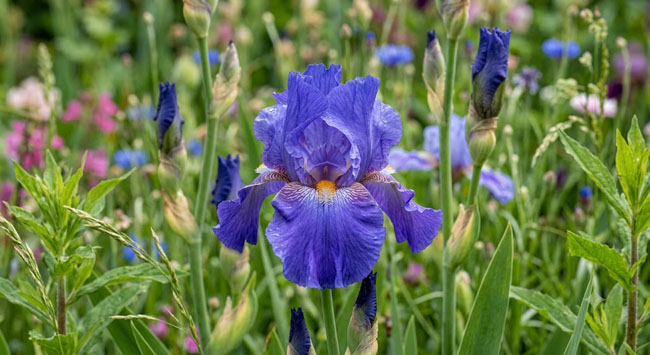
After noticing one particularly striking purple iris in a public garden, I began paying closer attention whenever I visited parks or flower festivals.
That’s when I realized not every iris looked the same.
Some flowers had fuzzy markings on their lower petals.
Others had wide, open blooms that looked almost like watercolor paintings.
At first, I assumed these were simply different colors of the same plant.
They weren’t.
Why Bearded Irises Stand Out
The first variety I learned about was the Bearded Iris.
Once someone pointed out the fuzzy strip running down the center of the lower petals, I couldn’t stop noticing it.
That fuzzy line, known as the “beard,” helps attract pollinators and gives the flower its name.
Beyond that unique feature, Bearded Irises have a dramatic appearance.
Their blooms often look heavily ruffled and come in an incredible range of colors, from deep purple and blue to yellow, white, peach, and even almost black.
What surprised me most was learning that these impressive flowers actually prefer relatively dry conditions.
Many people assume flowering plants need constant watering, but Bearded Irises dislike soggy soil.
Their rhizomes need excellent drainage, making them perfect for sunny garden beds rather than damp locations.
Japanese Irises Completely Changed My Expectations
The next variety I discovered was the Japanese Iris.
Compared to Bearded Irises, they have an entirely different personality.
Their flowers appear flatter, wider, and much more graceful.
Instead of bold, dramatic blooms, Japanese Irises have a quiet elegance.
Many varieties display beautiful veins and subtle color patterns that almost look hand-painted.
The biggest surprise, however, was their growing conditions.
Unlike Bearded Irises, Japanese Irises actually enjoy consistently moist soil.
Many gardeners plant them beside ponds or streams where the ground rarely dries out.
That was the moment I realized why treating every iris the same way can lead to disappointing results.
Plants that look similar don’t always want the same environment.
The Plant That Confuses Almost Everyone
While learning about irises, I kept coming across another plant that looked remarkably familiar.
Sweet Flag.
At first glance, it’s easy to understand why people mistake it for an iris.
The leaves are almost identical.
Tall.
Narrow.
Sword-shaped.
From a distance, even experienced gardeners sometimes take a second look.
The difference becomes obvious when flowering season arrives.
Instead of producing the large, colorful blooms people expect from irises, Sweet Flag develops small, understated flower spikes.
Although it lacks showy flowers, Sweet Flag has its own appeal.
Its graceful foliage works beautifully around ponds and water gardens, and it has a long history of traditional use in several Asian cultures.
That discovery reminded me that plants can be appreciated for far more than just their flowers.
Choosing the Right Plant for Your Garden
After learning more about these plants, I realized that selecting the right one depends less on appearance and more on your garden conditions.
If your garden receives plenty of sunshine and drains well after rain, a Bearded Iris is likely to reward you with spectacular blooms every spring.
If you already have a pond, rain garden, or naturally damp area, Japanese Irises are often a much better choice.
If your goal is to add texture and elegant foliage around water features, Sweet Flag deserves consideration even though it isn’t technically an iris.
Rather than asking which plant is “better,” it makes more sense to ask which one fits your growing environment.
That simple change in perspective makes gardening much more enjoyable.
A Few Things Worth Remembering
While reading about these plants and observing them in different gardens, a few practical lessons stood out.
Bearded Irises should never be planted too deeply because their rhizomes need exposure to warmth and air.
Japanese Irises should never be allowed to dry out completely during their active growing season.
Sweet Flag should not be purchased if you’re expecting colorful iris-like flowers, because its beauty comes almost entirely from its foliage.
Understanding these small differences can prevent frustration later and help each plant perform at its best.
Conclusion
Before learning more about irises, I assumed they were all variations of the same flower.
Now I see them very differently.
Bearded Irises impress with their bold structure and vibrant blooms.
Japanese Irises bring elegance to wet gardens and pond edges.
Sweet Flag proves that attractive foliage can be just as valuable as spectacular flowers.
Perhaps that’s what I enjoy most about gardening.
The more closely you look at plants, the more you realize that each one has its own character, preferences, and story.
If you’re planning to add one of these plants to your garden, spend a little time understanding its natural growing conditions before planting.
That small amount of preparation can make the difference between simply growing a plant and truly enjoying it for years to come.