If you’ve ever walked through a garden center in spring, you’ve probably seen rows of colorful flowering plants that look surprisingly similar.
I remember standing in front of a display filled with Petunias, Calibrachoas, and Surfinias, convinced they were all basically the same plant. The flowers looked alike, the colors were similar, and many of them were growing in hanging baskets.
It wasn’t until I started growing them myself that I realized there are important differences between these popular garden flowers. Some bloom more heavily, some require less maintenance, and some grow far larger than others.
Understanding those differences can help you choose the right plant for your garden, balcony, or container display.
Why These Flowers Are Often Confused
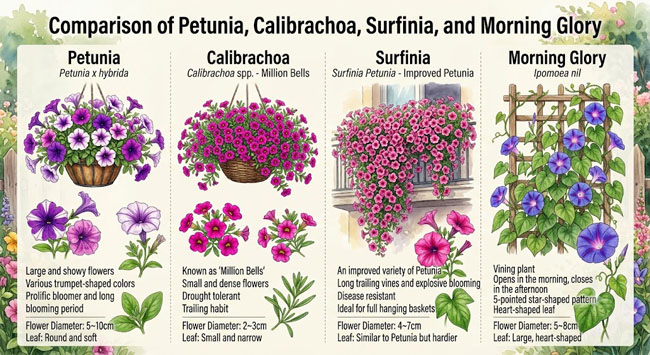
At first glance, Petunias, Calibrachoas, and Surfinias can look nearly identical.
All three produce trumpet-shaped flowers in a wide range of colors and are commonly used in hanging baskets, window boxes, and garden beds.
Because they are closely related, many gardeners assume they can be treated exactly the same way.
In practice, however, each plant has its own strengths and growing habits.
Morning Glory adds even more confusion because its flowers share a similar funnel shape, despite being a completely different type of plant.
Once you understand how each grows, telling them apart becomes much easier.
Petunia: The Classic Garden Favorite
Petunias are often the flowers most people recognize first.
Their larger blooms and endless color options have made them a favorite for decades.
One thing I appreciate about Petunias is their versatility. They work well in containers, flower beds, and hanging baskets, making them suitable for almost any garden style.
Traditional Petunias generally benefit from occasional deadheading, especially during peak summer flowering. Removing spent blooms encourages the plant to continue producing flowers rather than focusing its energy on seed production.
When healthy, a Petunia can provide months of continuous color from late spring through autumn.
Calibrachoa: Small Flowers, Big Impact
The first time I grew Calibrachoa, I assumed it was simply a smaller Petunia.
Many gardeners make the same mistake.
Often sold under the name “Million Bells,” Calibrachoa produces hundreds of small flowers that can completely cover the foliage during peak blooming season.
One of its biggest advantages is convenience.
Unlike traditional Petunias, Calibrachoa is largely self-cleaning. Old flowers typically drop on their own, reducing the need for constant maintenance.
Its leaves are also noticeably smaller and slightly sticky to the touch.
For gardeners who want continuous blooms with less work, Calibrachoa is often an excellent choice.
Surfinia: Built for Fast Growth
Surfinia deserves special attention because many gardeners do not realize it is actually a specific type of trailing Petunia.
If you’ve ever seen a hanging basket overflowing with flowers and cascading several feet downward, there is a good chance it was planted with Surfinia.
What impressed me most about Surfinia is its vigor.
Given enough sunlight, water, and fertilizer, it can grow remarkably quickly and fill a container far faster than many standard Petunia varieties.
The trade-off is that Surfinia tends to be hungry.
To maintain heavy flowering throughout summer, regular feeding becomes important.
Without sufficient nutrients, flowering may slow considerably.
Morning Glory: A Completely Different Plant
Despite having similarly shaped flowers, Morning Glory belongs in a category of its own.
Unlike Petunias, Calibrachoas, and Surfinias, Morning Glory is a climbing vine.
Instead of spilling over the edges of containers, it climbs fences, trellises, and garden structures.
One of my favorite things about Morning Glory is its daily rhythm.
The flowers open early in the morning and often begin closing later in the day, creating a display that changes as the hours pass.
Because of its climbing habit, Morning Glory is often used to create vertical interest in gardens rather than colorful ground-level displays.
Growing Them Successfully
Although these flowers have differences, they share several basic requirements.
Plenty of Sunlight
All of these plants perform best in full sun.
The more sunlight they receive, the more flowers they typically produce.
In my experience, plants receiving less than six hours of direct sunlight rarely reach their full potential.
Consistent Watering
Container-grown plants dry out surprisingly quickly during summer.
Petunias, Calibrachoas, and Surfinias often require frequent watering during periods of intense heat.
Morning Glory is generally more forgiving once established but still appreciates regular moisture.
Regular Feeding
Fast growth and constant blooming require energy.
A balanced liquid fertilizer applied every week or two can dramatically improve flowering performance throughout the season.
Which One Should You Choose?
The answer depends largely on your gardening goals.
Choose Petunia if you want classic flowers with large blooms.
Choose Calibrachoa if you prefer a lower-maintenance plant covered with hundreds of small flowers.
Choose Surfinia if you want dramatic cascading displays and maximum impact in hanging baskets.
Choose Morning Glory if you need a flowering vine for fences, trellises, or vertical garden features.
Each offers something unique, and many gardeners eventually find themselves growing more than one.
Conclusion
Petunias, Calibrachoas, Surfinias, and Morning Glories may seem similar at first, but understanding their growth habits reveals important differences.
The first time I started comparing them closely, I realized that choosing the right plant often has less to do with flower color and more to do with how the plant grows and how much maintenance it requires.
Whether you’re filling a hanging basket, brightening a patio, or covering a garden trellis, there’s a good chance one of these flowers will fit your needs perfectly.
The best way to discover your favorite may be the simplest: grow one this season and see how it performs in your own garden.