The first time I noticed Sigesbeckia glabrescens, I wasn’t actually looking for it.
I was walking along a narrow trail near a field in late autumn when I noticed several small seeds clinging stubbornly to my socks. At first, I assumed they came from some ordinary roadside weed. When I got home, however, curiosity got the better of me, and I started looking into where those seeds had come from.
That simple moment introduced me to a plant that many people walk past without ever noticing.
Sigesbeckia glabrescens, sometimes known as St. Paul’s Wort, is not the kind of plant that immediately attracts attention. It doesn’t produce spectacular blooms like roses or hydrangeas. It rarely appears in gardening magazines, and most people would probably classify it as a wild herb rather than an ornamental plant.
Yet the more I learned about it, the more interesting it became.
Its remarkable adaptability, traditional herbal significance, and ability to thrive in difficult conditions make it one of those plants that quietly earns respect over time. After observing it in the wild and learning more about how it grows, I began to appreciate why it has remained part of traditional herbal practices for generations.
For gardeners interested in native plants, medicinal herbs, or simply understanding the hidden stories behind common wild plants, Sigesbeckia glabrescens is worth a closer look.
A Plant Most People Ignore Until They Look Closer
One reason Sigesbeckia glabrescens often goes unnoticed is that it doesn’t fit most people’s idea of a beautiful garden plant.
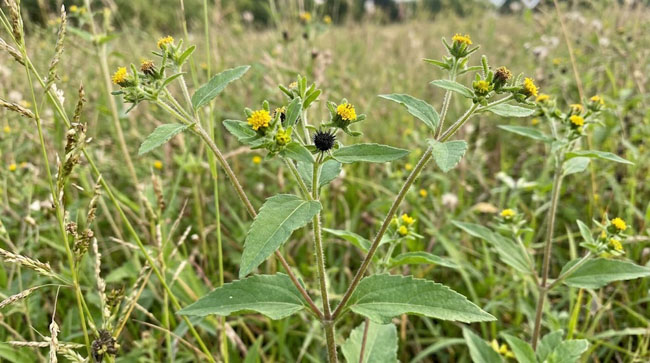
The flowers are relatively small and yellow, appearing from late summer into autumn. From a distance, they can easily blend into surrounding vegetation. Unlike many cultivated flowers, they do not demand attention.
In fact, if you saw the plant growing at the edge of a field, you might mistake it for a common weed.
That is exactly what I did.
But after spending more time observing it, I began noticing details that I had overlooked before.
The plant typically grows upright, often reaching between two and four feet in height depending on conditions. The stems branch freely, creating a somewhat open structure. Its leaves are broad, green, and slightly rough to the touch.
What fascinated me most, however, was its seed dispersal strategy.
As the seeds mature, they develop sticky surfaces that readily attach themselves to passing animals, clothing, and footwear. This natural mechanism allows the plant to spread its seeds far beyond the original growing area.
The first time I intentionally examined the seed heads, I was impressed by how effective this strategy was.
Without any human assistance, the plant had developed an efficient system for traveling across fields, trails, and open landscapes.
Observing these kinds of adaptations always reminds me that even the most ordinary-looking plants can reveal extraordinary solutions to survival.
Nature rarely wastes energy.
Every characteristic serves a purpose.
And Sigesbeckia glabrescens demonstrates that principle remarkably well.
Why This Humble Herb Has Been Valued for Generations
One of the reasons people continue to study Sigesbeckia glabrescens is its long history of traditional use.
For centuries, various species within the Sigesbeckia genus have been included in traditional herbal practices throughout East Asia. Historical records show that these plants were valued long before modern scientific research began examining their chemical composition.
When I first learned about its traditional uses, I found it interesting that such an unassuming plant had developed such a significant reputation.
Unlike herbs that are famous worldwide, Sigesbeckia glabrescens tends to remain relatively unknown outside specialized herbal communities.
Yet that does not diminish its historical importance.
Researchers have identified various naturally occurring compounds within the plant, including flavonoids and other bioactive constituents that continue to attract scientific interest.
Of course, it is important to approach discussions about medicinal plants carefully.
Traditional use does not automatically guarantee effectiveness, and anyone considering herbal applications should consult qualified professionals and rely on credible information sources.
Still, I find it fascinating how many plants with long histories of traditional use continue to draw scientific attention today.
What strikes me most is how often these plants are hiding in plain sight.
People frequently assume valuable plants must be rare, exotic, or difficult to grow.
Sigesbeckia glabrescens challenges that assumption.
It grows along roadsides, field margins, and open spaces where many people pass by every day without recognizing it.
That contrast between its modest appearance and its historical significance is part of what makes it so interesting.
Sometimes the most overlooked plants have the most compelling stories.
Growing Sigesbeckia glabrescens Successfully
One of the reasons I believe more gardeners could experiment with Sigesbeckia glabrescens is that it is surprisingly easy to grow.
Compared with many ornamental plants that require constant attention, this species tends to be remarkably resilient.
That does not mean it thrives under every condition, but it is certainly more forgiving than many cultivated garden plants.
Sunlight Matters More Than Anything Else
If there is one thing I have consistently observed, it is that Sigesbeckia glabrescens loves sunlight.
Most healthy wild populations seem to grow in open areas where they receive plenty of direct light throughout the day.
Plants growing in heavily shaded conditions often appear weaker and less vigorous.
If you plan to cultivate this species, choosing a location with at least six hours of direct sunlight is usually a good starting point.
Like many wild herbs, it performs best when allowed to grow in conditions that resemble its natural habitat.
Well-Draining Soil Encourages Strong Growth
One characteristic I appreciate about Sigesbeckia glabrescens is its adaptability.
It does not appear particularly demanding regarding soil type.
However, like many herbaceous plants, it dislikes constantly saturated conditions.
In my experience, poor drainage creates more problems than occasional dry periods.
When soil remains waterlogged for extended periods, root health can suffer, leading to weaker overall growth.
For garden cultivation, improving drainage is often more beneficial than adding large amounts of fertilizer.
A modest amount of organic matter combined with good drainage usually provides an excellent growing environment.
Avoid the Temptation to Overcare
This is perhaps the most common mistake gardeners make.
Because many cultivated plants respond well to regular feeding and intensive care, people sometimes assume wild herbs require similar treatment.
In reality, Sigesbeckia glabrescens evolved under relatively challenging conditions.
Excessive fertilization can actually encourage weak, overly lush growth.
I have noticed that plants growing in moderately fertile soil often develop stronger stems and a more balanced structure than those receiving excessive nutrients.
Sometimes the best approach is simply to provide suitable conditions and allow the plant to do what it naturally does best.
Seed Collection and Natural Propagation
Another fascinating aspect of growing this plant is how easily it reproduces.
Once mature plants produce seeds, natural dispersal often occurs without any effort from the gardener.
Those same sticky seeds that first caught my attention can help establish new plants in surrounding areas.
Gardeners who wish to collect seed can simply harvest mature seed heads in autumn and store them for spring sowing.
Germination is generally straightforward, making this species accessible even for beginners interested in native or medicinal plants.
The only caution is that its enthusiasm for self-seeding may occasionally exceed expectations.
Giving the plant sufficient space and monitoring seed spread can help maintain balance within the garden.
Conclusion
Sigesbeckia glabrescens may never become the centerpiece of a formal flower garden, but that is not what makes it valuable.
Its appeal lies elsewhere.
It is a plant that rewards curiosity.
At first glance, it appears ordinary, perhaps even insignificant. Yet a closer look reveals an impressive survival strategy, a long history of traditional use, and a remarkable ability to thrive in conditions that challenge many cultivated species.
My own interest in this plant began with a few seeds stuck to a sock after a walk.
What started as a simple observation became an appreciation for a species that most people overlook.
That experience serves as a reminder that some of the most interesting plants are not always the most colorful or famous.
Sometimes they are quietly growing along a roadside, waiting for someone to stop and pay attention.