
There was a time when I thought I was slowly losing the habit of reading.
It didn’t happen all at once.
I didn’t wake up one morning and decide that books no longer mattered.
Instead, reading quietly disappeared from my daily routine.
Whenever I had a few free minutes, I reached for my phone instead of a book.
If I was waiting in line, I checked social media.
If I had ten spare minutes before bed, I watched short videos.
If I had a question, I searched for a quick answer online.
Little by little, I became someone who consumed information all day without actually spending much time reading.
At first, I didn’t think there was a problem.
After all, I was still learning new things.
I listened to podcasts.
Watched documentaries.
Read articles.
Followed interesting creators.
I convinced myself that I hadn’t stopped learning.
I had simply changed the way I learned.
But after a while, I noticed something strange.
Although I was consuming more information than ever before, I couldn’t remember very much of it.
I finished one video and immediately started another.
I read one article and forgot it by the next morning.
Everything felt temporary.
My attention became shorter.
My thoughts became more scattered.
And perhaps most surprisingly, I found it harder to sit quietly with my own thoughts.
That was when I picked up a book again.
Not because someone told me I should.
Not because I had made a New Year’s resolution.
I simply missed the feeling of reading.
I didn’t realize it then, but opening that book reminded me of something I had forgotten.
Books don’t simply give us information.
They change the way we think.
Reading Asks Us to Slow Down
One of the first things I noticed after returning to books was how different the experience felt from scrolling through a screen.
The internet moves quickly.
Every page invites you to click something else.
Every video recommends another.
Every notification asks for your attention.
The goal is often to keep you moving.
Books do the opposite.
A book asks you to stay.
It doesn’t flash.
It doesn’t vibrate.
It doesn’t compete for your attention every few seconds.
It quietly waits until you’re ready.
At first, that felt surprisingly difficult.
My instinct was to check my phone every few pages.
I wondered how many messages I had missed.
I wanted to search for unrelated ideas that suddenly appeared in my mind.
It almost felt uncomfortable to focus on one thing for an extended period of time.
But after twenty or thirty minutes, something changed.
My breathing slowed.
My thoughts became clearer.
Instead of jumping from one topic to another, I stayed with a single idea long enough to understand it.
I realized that reading wasn’t simply exercising my mind.
It was calming it.
Screens Give Me Information. Books Give Me Perspective.
I have nothing against technology.
In fact, I use it every day.
Some of the most useful things I’ve learned came from online resources.
But I’ve noticed an important difference.
The internet is excellent at answering questions.
Books are excellent at asking better ones.
Online content often focuses on speed.
Books focus on depth.
An article might tell me what happened.
A book helps me understand why it happened.
A short video might summarize an idea in sixty seconds.
A book spends three hundred pages exploring it from every angle.
Neither is necessarily better.
They simply serve different purposes.
Sometimes I need a quick answer.
Other times I need wisdom.
Those are rarely the same thing.
Every Book Is a Conversation
One reason I continue reading is that every book feels like a conversation with someone I could never have met otherwise.
Sometimes that person lived hundreds of years ago.
Sometimes they grew up in a country I’ve never visited.
Sometimes they experienced struggles completely different from mine.
Yet for a few hours, I get to borrow their perspective.
That has always fascinated me.
A good book reminds me that my own experience is limited.
There are ways of thinking I haven’t considered.
Questions I haven’t asked.
Mistakes I haven’t made.
Lessons I haven’t learned.
Reading expands my world without requiring me to leave my chair.
The Books I Remember Are Connected to Seasons of My Life
One of my favorite things about books is that they often become attached to memories.
I can pick up a novel and immediately remember the café where I first opened it.
I can find an old bookmark and remember the trip during which I carried that book everywhere.
Sometimes I don’t even remember every chapter.
Instead, I remember how I felt while reading it.
Certain books remind me of difficult seasons.
Others remind me of hopeful beginnings.
A few remind me of long train rides, rainy afternoons, or quiet mornings with coffee.
It’s interesting how books become part of our personal history.
They don’t simply tell stories.
They become part of ours.
Not Every Book Needs to Change Your Life
For a long time, I felt pressure to read only important books.
Books everyone recommended.
Books that appeared on bestseller lists.
Books people described as “life-changing.”
Eventually I realized something.
Not every meal has to be unforgettable.
Not every conversation has to change your future.
Not every book has to transform your life.
Some books simply entertain.
Some make you laugh.
Some help you relax after a difficult week.
Some introduce one small idea that quietly stays with you for years.
That is enough.
Reading shouldn’t become another competition.
It should remain a source of curiosity and joy.
I No Longer Force Myself to Finish Every Book
This was one of the healthiest changes I made as a reader.
Years ago, I believed that once I started a book, I had to finish it.
Even if I wasn’t enjoying it.
Even if I wasn’t learning anything.
I kept reading because quitting felt like failure.
Now I think differently.
Life is too short to spend weeks reading something that isn’t helping me grow or bringing me joy.
If a book isn’t connecting with me, I simply put it back on the shelf.
Maybe I’ll return to it another year.
Maybe I won’t.
Interestingly, once I gave myself permission to stop reading books I didn’t enjoy, I started reading much more often.
My Bookshelf Became More Than Storage
Over time I noticed something else.
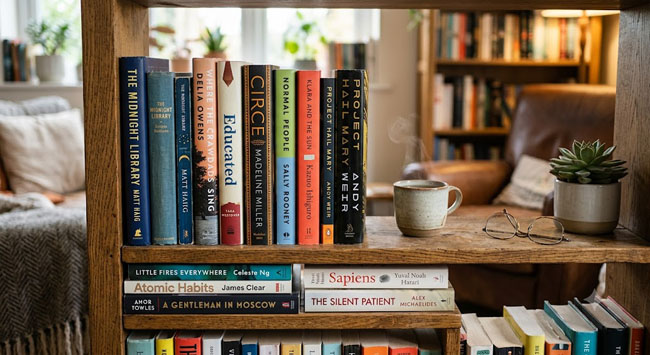
I enjoyed looking at my bookshelf almost as much as reading the books on it.
Each book reminded me of a season.
A question I was asking.
A challenge I was facing.
An idea that changed how I viewed the world.
When I see handwritten notes in the margins, I sometimes smile.
I remember exactly why I underlined a particular sentence.
Occasionally I disagree with something I highlighted years ago.
That makes me realize I’ve changed too.
A bookshelf isn’t simply a collection of books.
It’s a quiet record of personal growth.
Books Teach Humility
The more I read, the less I feel like I know everything.
At first that sounds discouraging.
It isn’t.
It’s freeing.
Books remind me how much wisdom exists beyond my own experience.
Every thoughtful author has spent years learning something I haven’t.
Instead of making me feel small, that fills me with curiosity.
There is always another perspective.
Another culture.
Another story.
Another lesson waiting to be discovered.
Reading Changed the Way I Listen
One unexpected gift of reading is that it changed the way I listen to other people.
Books taught me patience.
Instead of waiting for my turn to speak, I became more interested in understanding someone else’s point of view.
Good authors don’t rush their ideas.
Good listeners don’t rush people either.
Perhaps those two habits are more connected than I once realized.
Some Books Arrive at Exactly the Right Time
Have you ever read a book and wondered why everyone loved it?
Then years later you picked it up again and suddenly understood every page.
I’ve experienced that more than once.
The book hadn’t changed.
I had.
Certain books only make sense after we’ve lived enough life to understand them.
That’s one reason I rarely judge a book too quickly.
Sometimes the right book arrives in the wrong season.
Sometimes the wrong season eventually becomes the right one.
In a World That Never Stops Talking, Books Still Whisper
Modern life is loud.
News updates never stop.
Notifications constantly appear.
Everyone seems to have an opinion.
Books are different.
They don’t shout.
They whisper.
They invite instead of demanding.
Perhaps that’s why reading often feels peaceful.
It’s one of the few activities that encourages sustained attention without constant interruption.
Why I Think People Will Always Love Books
People have predicted the end of books many times.
Television was supposed to replace them.
Then computers.
Then smartphones.
Now artificial intelligence.
Yet books remain.
I don’t think that’s an accident.
Books satisfy something technology alone cannot.
They allow us to slow down.
To reflect.
To imagine.
To wrestle with difficult ideas.
To spend hours following a single train of thought without distraction.
As long as human beings remain curious, thoughtful, and hopeful, I believe books will continue to matter.
Not because they’re old-fashioned.
But because they meet a timeless human need.
Conclusion
When I first thought I had stopped reading, I assumed I had simply become too busy.
Now I think something else had happened.
I had become too accustomed to constant noise.
Books reminded me that depth requires time.
Understanding requires patience.
And wisdom rarely arrives at the same speed as information.
I still enjoy technology.
I still watch videos.
I still search for quick answers.
But whenever I want to think more deeply, understand another person, or simply slow down, I find myself reaching for a book.
Perhaps that’s why people still love books in a world full of screens.
Not because books compete with technology.
But because they offer something technology was never designed to replace.
They invite us to pause.
To think.
To imagine.
To grow.
Long after the screen has gone dark and the latest trend has been forgotten, the right book often remains on a shelf, quietly waiting.
And every time we open it, it has the remarkable ability to remind us not only who the author was—but who we were, who we have become, and who we might still become.
Maybe that is the greatest gift books have ever offered.
Not just knowledge.
But transformation.