
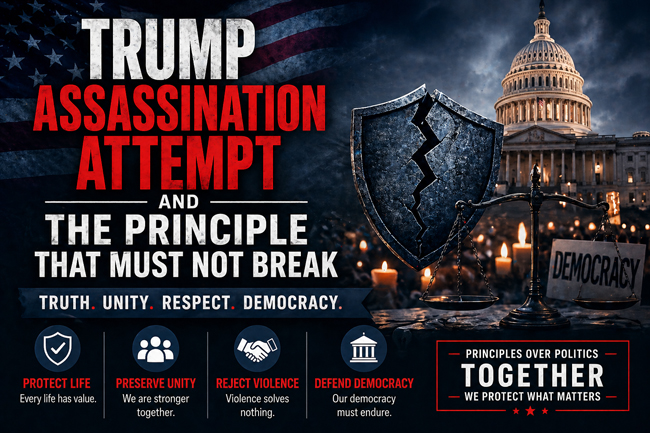
Trump Assassination Attempt Shows the Danger of Political Extremes
The recent Trump assassination attempt involving Donald Trump has once again brought global attention to the growing intensity of political division, not only in the United States but across the world, where ideological conflict is no longer limited to debate or disagreement but is increasingly expressed through hostility, dehumanization, and in extreme cases, acts of violence that cross a fundamental moral line. This incident cannot be viewed simply as an isolated act carried out by one individual, because it reflects a deeper environment in which political opponents are no longer seen as people to engage with but as threats to eliminate, and when that shift happens, the very foundation of civil society begins to erode in ways that are difficult to reverse. In such a climate, even the language used in political discourse becomes more aggressive and emotionally charged, creating a feedback loop where words gradually normalize actions that would otherwise be unthinkable, and this is precisely why events like the Trump assassination attempt must be taken seriously not just as security failures but as indicators of a broader cultural and moral problem that requires clear and deliberate response.
No Political Belief Justifies Violence as a Solution
At the center of this issue lies a principle that must remain non-negotiable: no political belief, position, or goal can ever justify violence as a legitimate solution, because once that line is crossed, the systems that allow societies to function—law, dialogue, accountability, and mutual recognition—begin to lose their authority and effectiveness, leading to a situation where power is no longer shaped by persuasion but by force. The Trump assassination attempt underscores how fragile this boundary can become when polarization intensifies, as individuals or groups may begin to rationalize extreme actions in the belief that their cause is urgent enough to override ethical constraints, yet history consistently demonstrates that violence does not resolve political conflict but rather amplifies it, creating cycles of retaliation and instability that are far more destructive than the disagreements they were meant to address. Maintaining a firm rejection of violence is therefore not merely a moral stance but a practical necessity for preserving order, protecting human dignity, and ensuring that political processes remain grounded in legitimacy rather than fear.
Why This Moment Requires Clarity, Not Emotion
In response to events like the Trump assassination attempt, it can be tempting to react emotionally, to align instinctively with one side or another, or to interpret the situation through the lens of existing political loyalties, but what is needed instead is clarity—a deliberate commitment to uphold principles that transcend immediate reactions and short-term narratives. This clarity begins with a simple but powerful statement: no political position should ever be resolved through violence, and this is not a passive or neutral stance but an active defense of the conditions that make peaceful coexistence possible, especially in times of deep division. Choosing this path requires discipline, because it resists the pull of outrage and refuses to validate harmful behavior even when it appears to serve one’s own perspective, and in doing so, it protects the integrity of both individuals and institutions. Ultimately, societies are not sustained by the absence of conflict but by the presence of shared boundaries, and reaffirming those boundaries in moments of crisis is what determines whether division leads to collapse or to a more stable and mature form of coexistence.
Conclusion: A Line That Must Never Be Crossed
The Trump assassination attempt involving Donald Trump ultimately forces us to confront a fundamental question about the kind of society we are willing to build and sustain, especially in an era defined by deep political division, rapid information flow, and increasingly emotional public discourse. While opinions, ideologies, and leadership preferences will always differ, the boundary that separates disagreement from destruction must remain absolutely clear and firmly protected, because once violence is accepted—even in rare or extreme circumstances—it reshapes expectations and lowers the threshold for future actions in ways that are difficult to control. This is why the principle that no political position should ever be resolved through violence is not merely an idealistic statement but a necessary foundation for any stable and functioning society, as it preserves both human dignity and the legitimacy of the systems designed to manage conflict peacefully. Moving forward, the responsibility does not lie only with governments or institutions, but with individuals who choose how to interpret, respond to, and speak about such events, because culture is shaped not only by major decisions but by countless small affirmations of what is acceptable and what is not. In that sense, reaffirming a clear rejection of political violence is not just a reaction to one event, but a commitment to a future where disagreement does not lead to harm, and where the strength of a society is measured not by its ability to overpower opposition, but by its discipline to uphold principles even under pressure.