
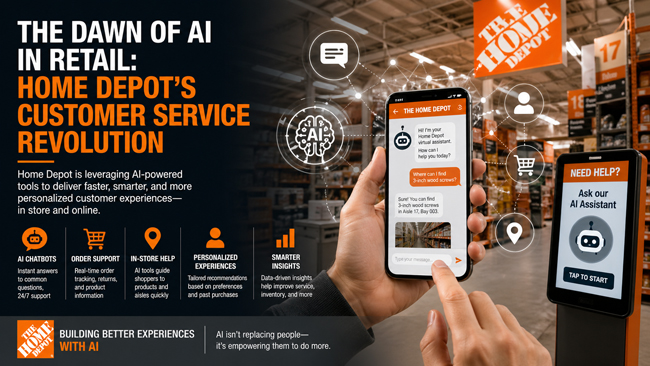
The Dawn of AI in Retail: Home Depot’s Customer Service Revolution
The retail landscape is undergoing a seismic shift, and at the forefront of this transformation is Artificial Intelligence (AI). Home Depot, a titan in the home improvement sector, is not just observing this change; it’s actively shaping it by integrating AI into its customer service operations. This isn’t about replacing human interaction entirely, but rather about augmenting it, making it more efficient, personalized, and accessible than ever before.
For many shoppers, customer service can be a point of friction. Long wait times, repetitive questions, and difficulty finding specific information can lead to frustration. Home Depot’s foray into AI customer service aims to tackle these pain points head-on, offering a glimpse into the future of retail interaction. From AI-powered chatbots that provide instant answers to complex in-store navigation tools, the company is investing heavily in technology to elevate the customer journey.
This article will delve into the various ways Home Depot is implementing AI to enhance its customer service. We’ll explore the technologies being used, the benefits they bring to shoppers, and what this means for the future of retail. Whether you’re a seasoned DIYer or a first-time homeowner, understanding these advancements can significantly improve your shopping experience.
Understanding the “Why”: The Need for AI in Customer Service
Before diving into the “how,” it’s crucial to understand the “why.” The modern consumer expects more. They want immediate gratification, personalized experiences, and seamless interactions across all touchpoints. Traditional customer service models, while valuable, often struggle to keep pace with these evolving demands.
-
Scalability: As customer interactions increase, especially during peak seasons or promotional events, human agents can become overwhelmed. AI can handle a massive volume of inquiries simultaneously, ensuring no customer is left waiting.
-
Availability: Customer needs don’t adhere to business hours. AI-powered tools can provide 24/7 support, answering common questions and guiding customers regardless of the time of day.
-
Personalization: AI can analyze vast amounts of data, including past purchases, browsing history, and stated preferences, to offer tailored recommendations and solutions. This moves beyond generic advice to truly individualized support.
-
Efficiency: AI can automate repetitive tasks, freeing up human agents to focus on more complex, nuanced issues that require human empathy and problem-solving skills. This leads to faster resolution times for all types of queries.
-
Data-Driven Insights: AI systems generate valuable data on customer behavior and pain points, providing retailers with actionable insights to continuously improve their products and services.
Home Depot, with its extensive product catalog and diverse customer base, stands to gain immensely from these AI-driven advantages. The goal is not to dehumanize the shopping experience but to make it more responsive and tailored to individual needs.
Home Depot’s AI Toolkit: Chatbots, Virtual Assistants, and Beyond
Home Depot isn’t relying on a single AI solution. Instead, it’s deploying a suite of technologies designed to address different aspects of the customer journey.
AI-Powered Chatbots: Your First Line of Support
Chatbots have become a ubiquitous feature on many retail websites, and Home Depot is no exception. However, the chatbots being deployed are increasingly sophisticated, powered by Natural Language Processing (NLP) and Machine Learning (ML).
-
Instantaneous Responses: When you have a quick question about product availability, store hours, or return policies, an AI chatbot can provide an immediate answer. This eliminates the need to wait for an email response or navigate through extensive FAQs.
-
Product Information and Recommendations: Chatbots can access Home Depot’s vast product database to provide detailed specifications, compare products, and even suggest items based on your stated needs. For example, you could ask, “What’s the best type of paint for a bathroom?” and the chatbot could guide you through the options.
-
Order Tracking and Status Updates: Need to know where your online order is? A chatbot can quickly pull up your order information and provide real-time tracking updates.
-
Troubleshooting Basic Issues: For common DIY problems or product usage questions, chatbots can offer step-by-step guidance or link you to relevant tutorials and support articles.
The effectiveness of these chatbots lies in their ability to understand user intent, even when questions are phrased in different ways. As they interact with more customers, their understanding and accuracy improve over time, thanks to machine learning algorithms.
Virtual Assistants for Enhanced In-Store and Online Experiences
Beyond chatbots, Home Depot is exploring more advanced virtual assistant technologies to create a more immersive and helpful experience.
-
In-Store Navigation: Imagine walking into a massive Home Depot store and being able to ask your phone, “Where can I find 3-inch wood screws?” A virtual assistant, potentially integrated with store maps and augmented reality (AR) features, could guide you directly to the correct aisle and even the specific shelf. This technology is still evolving but holds immense potential for improving the in-store experience.
-
Personalized Project Assistance: For larger projects, customers often need more than just product information; they need guidance. AI-powered virtual assistants can help customers plan projects, create shopping lists, estimate material needs, and even offer advice on techniques, drawing from a vast repository of expert knowledge.
-
Smart Home Integration: As smart home technology becomes more prevalent, AI assistants can play a role in helping customers select, install, and manage compatible devices, offering a seamless integration of smart home solutions into their existing setup.
These virtual assistants aim to replicate the helpfulness of a knowledgeable store associate, but with the added benefits of instant availability and personalized data access.
Behind the Scenes: AI Optimizing Operations
The impact of AI at Home Depot extends beyond direct customer interaction. The company is also using AI to optimize its internal operations, which indirectly benefits the customer.
-
Inventory Management: AI algorithms can predict demand for specific products with greater accuracy, helping Home Depot maintain optimal stock levels. This reduces the chances of popular items being out of stock.
-
Supply Chain Optimization: AI can analyze logistics data to streamline the movement of goods, ensuring products reach stores and customers more efficiently.
-
Personalized Marketing: By analyzing customer data, AI can help Home Depot deliver more relevant promotions and product recommendations through email, app notifications, and website content, making marketing efforts less intrusive and more valuable.
These behind-the-scenes applications of AI contribute to a smoother, more reliable shopping experience for everyone.
The Benefits for Home Depot Customers
The integration of AI into Home Depot’s customer service framework translates into tangible benefits for shoppers.
1. Faster and More Efficient Support
The most immediate benefit is speed. AI chatbots and virtual assistants can answer common questions in seconds, drastically reducing wait times. This is particularly valuable for customers who need quick answers to get their projects moving.
2. Personalized Recommendations and Advice
AI’s ability to process data allows for a level of personalization that was previously unattainable. Whether it’s suggesting the right tools for a specific task, recommending complementary products, or offering project-specific advice, AI can tailor the experience to the individual customer’s needs and past behavior.
- Example: A customer who frequently buys paint might receive recommendations for new paint tools or primers, while someone who recently purchased flooring might get suggestions for underlayment or cleaning products.
3. Improved Accessibility and Convenience
With 24/7 availability through chatbots and the potential for in-store navigation assistance, AI makes accessing information and support more convenient than ever. Customers can get help when and where they need it, whether they’re browsing online at midnight or in the middle of a busy store.
4. Enhanced Product Discovery
Navigating Home Depot’s extensive inventory can be daunting. AI tools can act as intelligent guides, helping customers discover products they might not have found otherwise, based on their project needs or stated preferences. This can lead to better purchasing decisions and more successful projects.
5. Smoother Online and In-Store Integration
AI can help bridge the gap between online and in-store experiences. For instance, a customer might research a product online using an AI assistant, add it to a digital shopping list, and then use an in-store navigation feature to find it quickly once they arrive at the store.
Addressing Concerns: The Human Element in AI Customer Service
A common concern surrounding AI in customer service is the potential loss of the human touch. Customers often value the empathy, understanding, and complex problem-solving abilities that human agents provide. Home Depot, like many forward-thinking retailers, recognizes this and aims for a hybrid approach.
-
Seamless Handoff: AI systems are designed to recognize when a query is too complex or requires human intervention. In such cases, the AI can seamlessly transfer the customer to a live agent, providing the agent with the context of the previous interaction. This prevents the customer from having to repeat themselves.
-
Focus on Complex Issues: By automating routine inquiries, AI frees up human associates to handle more challenging customer issues, provide expert advice, and build stronger customer relationships. This allows human agents to focus on tasks where their skills are most valuable.
-
Augmenting, Not Replacing: The goal of AI in this context is to augment the capabilities of human employees, not to replace them entirely. AI tools can provide associates with quick access to information, customer history, and product details, empowering them to serve customers more effectively.
The ideal scenario is a partnership between AI and human agents, where each plays to their strengths to deliver the best possible customer experience.
The Future of Home Depot Customer Service with AI
The integration of AI at Home Depot is an ongoing journey, not a destination. As AI technology continues to advance, we can expect even more innovative applications.
-
Predictive Support: AI could potentially anticipate customer needs before they even arise. For example, if a customer recently purchased a specific appliance, AI might proactively offer maintenance tips or information about related accessories.
-
Hyper-Personalization: As AI gains a deeper understanding of individual customer preferences and project histories, recommendations and support will become even more finely tuned.
-
Advanced AR/VR Integration: Imagine using AR to visualize how a new paint color will look on your walls or how a piece of furniture will fit in your room, with AI guiding the process and providing real-time feedback.
-
Voice-Activated Shopping and Support: Further development in voice recognition and natural language understanding will likely lead to more sophisticated voice-activated shopping experiences and customer support.
Home Depot’s commitment to AI signals a broader trend in retail: a move towards more intelligent, responsive, and customer-centric service models. By embracing these technologies, the company is positioning itself to meet the evolving expectations of today’s consumers and to lead the way in the future of home improvement retail.
Conclusion: A Smarter Way to Shop for Your Home
Home Depot’s adoption of AI in customer service is a strategic move to enhance efficiency, personalization, and overall customer satisfaction. From AI-powered chatbots providing instant answers to the potential for sophisticated in-store navigation and project assistance, these technologies are designed to make shopping for home improvement projects easier and more effective.
While the human element remains crucial, AI acts as a powerful tool to augment human capabilities, automate routine tasks, and provide data-driven insights. This hybrid approach ensures that customers receive timely support for simple queries and expert, empathetic assistance for complex needs.
As AI technology continues to evolve, Home Depot is well-positioned to offer increasingly innovative and personalized customer experiences. Embracing these advancements means a smarter, more convenient, and ultimately more successful shopping journey for every customer.
Here are a few key takeaways to remember:
-
Embrace the Chatbots: For quick questions about products, orders, or store information, start with the AI chatbots on Home Depot’s website or app.
-
Look for Personalization: Pay attention to product recommendations and project advice offered through AI; they are often tailored to your specific needs.
-
Understand the Hybrid Model: Recognize that AI is there to assist, not replace, human experts. Don’t hesitate to ask for a human agent if your issue is complex.
-
Stay Curious: Keep an eye on how Home Depot continues to integrate AI, as future innovations promise even greater convenience and support.