The Driving Forces: South Korea’s Semiconductor and Battery Industries
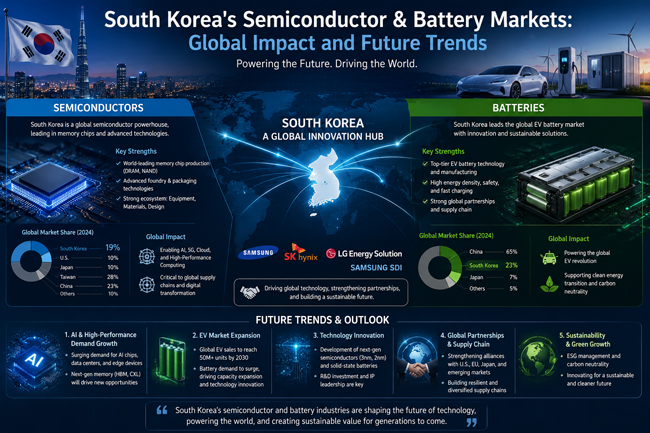
South Korea stands as a global powerhouse in two of the most critical industries of the 21st century: semiconductors and secondary batteries. These sectors are not merely economic engines for the nation; they are foundational to global technological advancement and the ongoing transition to a sustainable future. Understanding the dynamics of these markets is crucial for grasping the broader landscape of international trade, technological innovation, and geopolitical strategy.
Semiconductors: The Brains of Modern Technology
The semiconductor industry is the bedrock of the digital age. From the smartphones in our pockets to the complex artificial intelligence systems shaping our future, semiconductors are indispensable. South Korea, particularly through companies like Samsung Electronics and SK Hynix, has cemented its position as a leader in memory semiconductors, a segment characterized by intense competition and rapid technological evolution.
-
Memory Market Dominance: South Korea’s strength lies predominantly in DRAM (Dynamic Random-Access Memory) and NAND flash memory. These components are vital for data storage and processing in virtually all electronic devices. The nation’s continuous investment in research and development, coupled with massive production capacities, has allowed it to maintain a significant market share, often dictating global supply and pricing trends.
-
The Rise of Advanced Packaging: Beyond memory, the industry is increasingly focusing on advanced packaging technologies. As traditional chip scaling faces physical limitations, innovative packaging solutions are becoming critical for enhancing performance and functionality. South Korean companies are actively investing in this area, aiming to stay ahead of the curve in the competitive foundry and logic chip sectors.
-
Challenges and Opportunities: While dominant in memory, South Korea faces stiff competition in the non-memory (logic) semiconductor sector, where companies like TSMC (Taiwan) and Intel (USA) hold significant sway. The global push for supply chain diversification and national semiconductor self-sufficiency presents both challenges and opportunities, prompting increased government support and private sector investment in areas like advanced logic chip manufacturing and design.
Secondary Batteries: Powering the Green Revolution
The secondary battery, or rechargeable battery, market is another area where South Korea has demonstrated exceptional leadership. Driven by the booming electric vehicle (EV) market and the growing demand for energy storage systems (ESS), companies like LG Energy Solution, Samsung SDI, and SK On are at the forefront of innovation and production.
-
Electric Vehicle Dominance: The electrification of transportation is a major global trend, and South Korean battery manufacturers are key enablers of this shift. They supply batteries to major global automakers, consistently pushing the boundaries of energy density, charging speed, and safety. Their technological prowess has positioned them as indispensable partners in the automotive industry’s transition to EVs.
-
Beyond EVs: Energy Storage Systems (ESS): The need for stable and efficient energy grids is growing, especially with the increasing integration of renewable energy sources. South Korean companies are also significant players in the ESS market, providing solutions for grid stabilization, peak shaving, and backup power. This diversification is crucial for their long-term growth and contribution to a sustainable energy future.
-
Technological Advancements: The race for next-generation battery technology is intense. South Korean firms are heavily invested in developing solid-state batteries, which promise higher safety, greater energy density, and faster charging compared to current lithium-ion technologies. Continuous innovation in materials science and manufacturing processes is key to maintaining their competitive edge.
-
Supply Chain and Raw Material Concerns: A significant challenge for the secondary battery industry is the reliance on raw materials like lithium, cobalt, and nickel, which are often sourced from politically sensitive regions. South Korean companies are actively working to secure stable supply chains, explore alternative materials, and enhance recycling capabilities to mitigate these risks and ensure sustainable growth.
Global Impact and Competitive Landscape
The influence of South Korea’s semiconductor and battery industries extends far beyond its borders. These sectors are deeply intertwined with global supply chains, technological innovation, and international economic relations.
Semiconductors: A Geopolitical Chessboard
The semiconductor industry has become a focal point of geopolitical competition. The concentration of advanced manufacturing in a few regions, particularly Taiwan and South Korea, has raised concerns among nations about supply chain resilience and national security.
-
US-China Tech Rivalry: The ongoing technological competition between the United States and China has significantly impacted the semiconductor industry. Export controls and restrictions on technology transfer have created a complex operating environment for global players, including South Korean firms, who must navigate these evolving dynamics carefully.
-
Supply Chain Diversification Efforts: In response to geopolitical risks and supply chain disruptions (highlighted by the COVID-19 pandemic), many countries are actively encouraging domestic semiconductor production. This has led to significant investments in new fabrication plants (fabs) in regions like the US and Europe, potentially reshaping the global manufacturing landscape in the long term.
-
Interdependence: Despite diversification efforts, the global semiconductor ecosystem remains highly interdependent. South Korea’s expertise in memory and advanced manufacturing, coupled with Taiwan’s dominance in foundry services, creates a complex web of collaboration and competition that is difficult to unravel.
Secondary Batteries: Fueling the Global Energy Transition
South Korea’s battery manufacturers are critical enablers of the global transition to clean energy. Their ability to produce high-quality, high-performance batteries at scale is vital for the widespread adoption of electric vehicles and renewable energy solutions.
-
Automaker Partnerships: Close collaboration with global automakers is a hallmark of the South Korean battery industry. These partnerships ensure that battery technology is aligned with vehicle design and performance requirements, accelerating the EV revolution.
-
Competition from China and Europe: While South Korean companies lead in many technological aspects, they face strong competition, particularly from Chinese battery manufacturers like CATL, which has a significant market share and cost advantages. European companies are also investing heavily to build their own battery production capabilities to reduce reliance on Asian suppliers.
-
Raw Material Sourcing Strategies: Securing a stable and ethical supply of raw materials is a global challenge. South Korean companies are actively pursuing strategies such as direct investment in mining operations, long-term supply agreements, and the development of battery recycling technologies to build more resilient and sustainable supply chains.
Future Outlook and Innovation Trajectories
The future of South Korea’s semiconductor and battery industries hinges on continued innovation, strategic investment, and adaptability to a rapidly changing global environment.
Semiconductors: Beyond Moore’s Law
The semiconductor industry is constantly seeking ways to overcome the physical limitations of traditional scaling.
-
AI and High-Performance Computing: The explosive growth of artificial intelligence and the demand for high-performance computing (HPC) are driving innovation in specialized chips, advanced architectures, and novel materials. South Korean companies are investing in R&D to capture opportunities in these burgeoning segments.
-
System Semiconductors and Foundries: While memory remains a stronghold, there is a concerted effort to bolster the system semiconductor (non-memory) sector and expand foundry capabilities. This includes developing expertise in areas like AI accelerators, automotive chips, and advanced logic processes.
-
Talent Development and Ecosystem Building: The long-term success of the industry depends on a strong pipeline of skilled engineers and researchers. Government initiatives and industry collaborations are crucial for fostering talent development and building a robust domestic semiconductor ecosystem.
Secondary Batteries: The Next Generation of Power
The pursuit of superior battery technology is relentless, with a focus on enhanced safety, performance, and sustainability.
-
Solid-State Batteries: This is widely considered the next frontier in battery technology. South Korean companies are investing heavily in R&D for solid-state batteries, aiming to overcome manufacturing challenges and bring this transformative technology to market.
-
Advanced Materials and Chemistry: Research into new cathode and anode materials, as well as innovative electrolyte formulations, is crucial for improving battery performance and reducing costs. This includes exploring chemistries beyond lithium-ion, such as sodium-ion batteries, for specific applications.
-
Circular Economy and Sustainability: As the demand for batteries grows, so does the importance of sustainability. South Korean companies are increasingly focusing on developing efficient battery recycling processes and exploring the use of recycled materials to create a more circular economy for battery production.
Conclusion: Pillars of Korea’s Economic Future
South Korea’s semiconductor and secondary battery industries are not just economic powerhouses; they are critical enablers of global technological progress and the transition to a sustainable future. Despite facing intense global competition and complex geopolitical challenges, the nation’s commitment to innovation, strategic investment, and strong industry-academia collaboration positions it to remain at the forefront of these vital sectors.
The continued success of these industries will depend on their ability to:
-
Accelerate R&D and Commercialization: Steadily invest in next-generation technologies like AI chips and solid-state batteries, and expedite their path to market.
-
Strengthen Supply Chain Resilience: Proactively manage raw material sourcing, enhance recycling capabilities, and diversify production bases to mitigate geopolitical risks.
-
Foster a Skilled Workforce: Continuously invest in education and training programs to secure a pipeline of top talent essential for driving future innovation.
By navigating these challenges and seizing emerging opportunities, South Korea’s semiconductor and battery industries are poised to continue shaping the global technological landscape for decades to come.