
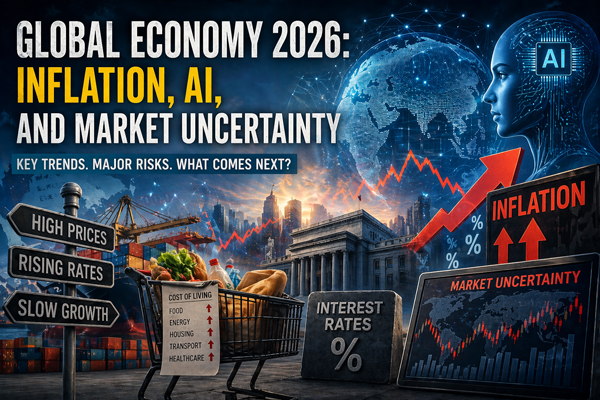
The global economy in 2026 is being shaped by a powerful mix of inflation pressures, rapid technological change, and geopolitical uncertainty. From rising interest rates to the explosive growth of artificial intelligence (AI), businesses and consumers alike are navigating a landscape that feels both full of opportunity and risk. As governments attempt to stabilize growth while avoiding recession, understanding the key economic trends has become more important than ever.
Inflation, Interest Rates, and Cost of Living Pressure
Inflation remains one of the most talked-about economic issues worldwide. Although some countries have seen inflation slow compared to previous years, the cost of living is still significantly higher than before. Food, housing, and energy prices continue to strain household budgets, especially for middle- and low-income families. For many people, wages have not kept pace with rising expenses, creating a growing gap between income and daily living costs.
This ongoing pressure is changing consumer behavior. Households are cutting back on discretionary spending such as travel, dining, and entertainment in order to prioritize essential needs. In some cases, families are taking on additional debt just to maintain their standard of living. This trend is particularly concerning because it can lead to long-term financial instability and reduced economic mobility.
Central banks, including the Federal Reserve, have responded by maintaining relatively high interest rates as a way to control inflation. Higher interest rates help slow down excessive spending and borrowing, which can reduce price increases over time. However, this approach also comes with trade-offs.
As borrowing becomes more expensive, mortgage rates rise, making it harder for people to buy homes. Credit card interest rates also increase, placing additional pressure on consumers who rely on credit for everyday expenses. Businesses face higher costs when taking out loans for expansion or operations, which can lead to reduced hiring, delayed projects, or even layoffs.
As a result, consumers are spending more cautiously, and companies are delaying investments, which can slow overall economic growth. This creates a delicate balance for policymakers, who must manage inflation without pushing the economy into a recession. The challenge is not only to stabilize prices but also to support sustainable growth in an increasingly uncertain global economic environment.
The AI Boom and the Future of Jobs
Artificial intelligence is one of the hottest economic keywords of 2026. Companies across industries are investing heavily in AI to improve efficiency, reduce costs, and gain competitive advantages. From automated customer service to advanced data analysis, AI is transforming how businesses operate. In sectors such as finance, healthcare, manufacturing, and retail, AI-driven systems are helping organizations process large amounts of data faster and make more accurate decisions.
This rapid adoption is also accelerating innovation. Businesses are using AI to personalize customer experiences, optimize supply chains, and develop new products and services. As a result, companies that successfully integrate AI into their operations are gaining a significant edge over competitors who are slower to adapt. This growing gap is reshaping entire industries and redefining what it means to stay competitive in the global market.
However, this rapid shift also raises concerns about the future of jobs. While AI creates new opportunities in tech and innovation sectors, it may also replace certain roles, particularly repetitive or administrative positions. Tasks that once required human labor—such as data entry, basic analysis, and customer support—are increasingly being automated.
This transformation is forcing workers and organizations to rethink skills and career paths. Governments and businesses are now focusing on reskilling and upskilling workers to adapt to this changing job market. Education systems are also evolving, placing greater emphasis on digital literacy, critical thinking, and creativity—skills that are less likely to be replaced by automation.
At the same time, new types of jobs are emerging. Roles related to AI development, data science, cybersecurity, and ethical AI governance are in high demand. This shift suggests that while some jobs may disappear, others will be created, leading to a restructuring rather than a complete loss of employment opportunities.
Major tech companies like OpenAI and Google are leading this transformation, pushing the boundaries of what AI can achieve while also influencing global economic dynamics. Their innovations are not only shaping the future of technology but also redefining productivity, competitiveness, and economic growth on a global scale.
Global Uncertainty: Supply Chains and Geopolitics
Geopolitical tensions continue to impact the global economy. Conflicts, trade disputes, and shifting alliances are affecting supply chains and increasing uncertainty for businesses. Disruptions in key regions can lead to shortages of essential goods, delays in production, and higher transportation costs. These challenges have become more visible in recent years, as global trade networks prove to be more fragile than previously expected.
Energy markets are especially sensitive to geopolitical risks. Tensions in major oil-producing regions can quickly drive up energy prices, which in turn affects transportation, manufacturing, and overall inflation. This creates a ripple effect across economies, influencing everything from fuel costs to food prices.
At the same time, countries are rethinking their economic strategies by diversifying supply chains and investing in domestic production. This trend, often referred to as “economic resilience,” aims to reduce dependence on a single region or supplier. Governments are encouraging companies to relocate manufacturing closer to home or to partner with multiple countries to minimize risk.
This shift is also reshaping global trade patterns. While globalization once emphasized efficiency and low costs, the current focus is increasingly on stability and security. Businesses are prioritizing reliability over speed, even if it means higher operational expenses. As a result, regional trade partnerships are becoming more important than ever.
Financial markets remain highly sensitive to global events. Investors closely monitor developments in energy markets, international relations, and government policies, leading to increased volatility in stock and currency markets. Even minor geopolitical developments can trigger rapid market reactions, as uncertainty influences investor confidence.
In this environment, companies and investors are placing greater emphasis on risk management and long-term planning. The ability to adapt quickly to changing global conditions is becoming a key factor for success in an increasingly unpredictable economic landscape.
Conclusion: Navigating a Changing Economic Landscape
The global economy in 2026 stands at a turning point. Inflation, technological disruption, and geopolitical uncertainty are reshaping how people live, work, and invest. While challenges remain, these changes also present new opportunities for growth and innovation.
For individuals and businesses, staying informed and adaptable is key. Whether it’s managing personal finances, exploring new career paths, or adjusting investment strategies, understanding the forces driving the economy can help navigate an increasingly complex world.