
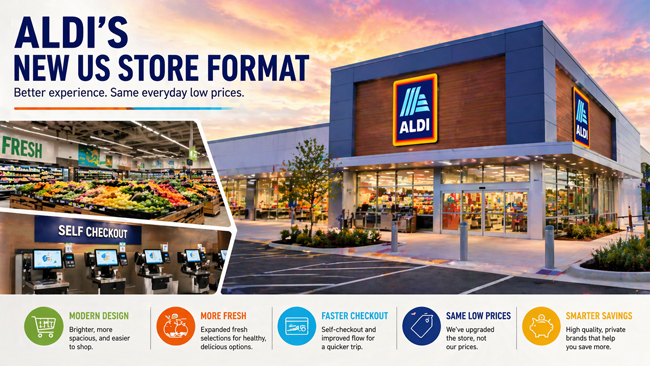
Aldi is rolling out a new store format across the United States, and it signals more than a simple refresh. For years, Aldi built its reputation on ultra-low prices, limited assortments, and no-frills efficiency. Now, the brand is evolving—upgrading layouts, expanding fresh offerings, and refining the in-store experience—while trying to protect the price advantage that made it a favorite among budget-conscious shoppers.
This shift comes at a moment when U.S. consumers are highly price-sensitive but also expect convenience, quality, and a pleasant shopping environment. The result is a hybrid approach: keep the DNA of a discount grocer, but present it in a more modern, flexible, and shopper-friendly format.
What’s Changing in Aldi’s New US Store Format
The most visible updates are in store design and layout. New and remodeled locations feature brighter lighting, wider aisles, and clearer wayfinding. The goal is to reduce friction—help shoppers find items faster, navigate more easily, and move through checkout with less stress. While Aldi still emphasizes efficiency, the new format places greater importance on comfort and clarity.
Fresh food is another focal point. Many stores are expanding produce sections, adding more ready-to-cook and ready-to-eat options, and improving refrigeration displays. This aligns with broader U.S. grocery trends, where shoppers increasingly prioritize fresh, convenient meals without sacrificing value. Aldi’s private-label strategy remains central, but packaging and presentation are being refined to feel more contemporary and competitive on quality.
Technology and operations are also evolving. Self-checkout is being introduced in select markets to speed up transactions during peak hours. Back-of-house processes are optimized to keep shelves stocked with fewer staff, preserving Aldi’s lean operating model. The famous “bring your own bag” culture and cart deposit system largely remain, but the overall experience feels more polished and accessible to new customers.
Importantly, Aldi is not abandoning its core. The limited assortment model—fewer SKUs than traditional supermarkets—still drives purchasing power and lower prices. The new format simply packages that efficiency in a way that better matches current expectations.
Why Aldi Is Evolving in the US Market
The U.S. grocery landscape is intensely competitive. Traditional supermarkets, warehouse clubs, and e-commerce players are all vying for the same customer. Discount competitors, including Walmart and Dollar General, continue to pressure prices, while premium grocers attract shoppers with curated experiences and specialty products. Aldi’s new format is a strategic response to both ends of that spectrum.
Consumer behavior has also shifted. Inflation has made price a top priority, but it hasn’t erased expectations around quality and convenience. Shoppers want value, yet they also want a store that feels clean, easy to shop, and aligned with healthier lifestyles. By upgrading the in-store experience and expanding fresh options, Aldi aims to capture a broader audience without losing its core base.
Another factor is real estate and expansion. Aldi has been rapidly increasing its U.S. footprint, entering new neighborhoods and converting or remodeling older stores. A consistent, modern format helps the brand scale more effectively and compete in diverse markets—from suburban areas to urban neighborhoods where space, traffic flow, and shopper needs vary.
Finally, supply chain resilience plays a role. A tighter assortment and strong private-label control allow Aldi to manage costs and availability more effectively than many competitors. The new format supports this by improving inventory flow and reducing operational complexity, even as the customer-facing experience becomes more refined.
What It Means for Shoppers and the Future of Discount Retail
For shoppers, the new Aldi format offers a clearer value proposition: low prices combined with a better overall experience. The improvements in layout and fresh food make it easier to complete a full weekly shop in one trip, rather than using Aldi as a supplemental stop. Faster checkout options and improved navigation can also reduce total shopping time—a key benefit for busy households.
There are trade-offs. A more polished store environment can introduce slight cost pressures, and some purists may worry about “mission drift” away from hard-discount simplicity. However, Aldi’s model depends on maintaining price leadership. If upgrades do not translate into tangible shopper benefits—speed, clarity, freshness—they risk undermining the brand. So far, the changes are designed to be incremental and disciplined, not extravagant.
For the broader retail industry, Aldi’s move is significant. It reflects a larger trend: discount retail is no longer synonymous with bare-bones environments. Instead, leading players are blending efficiency with experience. Competitors are likely to respond with their own upgrades—whether through store remodels, private-label expansion, or checkout innovations—intensifying competition across price tiers.
Looking ahead, the success of Aldi’s new format will depend on execution. Consistency across locations, reliable product quality, and a clear in-store journey will determine whether shoppers perceive real value. If Aldi can maintain its cost advantage while delivering a smoother, more appealing experience, it could strengthen its position as one of the most disruptive forces in U.S. grocery retail.
In a market shaped by inflation, changing preferences, and fierce competition, Aldi’s new U.S. store format is a calculated evolution. It keeps the core promise—value—while adapting to how people actually shop today. For consumers, that means a faster, easier, and more complete shopping trip. For the industry, it signals that the future of discount retail will be defined not just by price, but by how effectively brands combine efficiency with experience.