
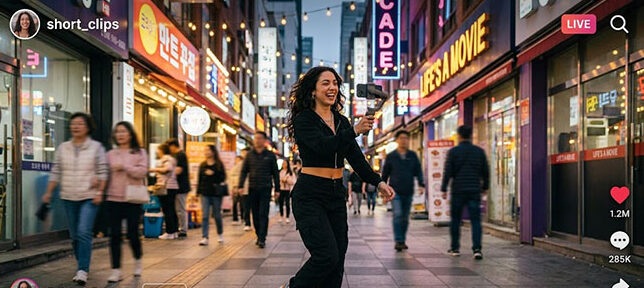
A few years ago, watching a ten- or twenty-minute video felt completely normal.
If I wanted to learn something new, I would read an entire blog post or watch a detailed tutorial from beginning to end. When I discovered an interesting book, I would set aside time to read it slowly instead of rushing through it.
Somewhere along the way, however, my habits changed without me realizing it.
Today, I can open my phone intending to watch just one short video, only to discover an hour has disappeared. My thumb keeps moving almost automatically, swiping from one thirty-second clip to the next. Each video feels so brief that it never seems like I’m spending very much time, yet together they consume far more time than I expected.
As someone who creates digital content, I’ve experienced this shift from both sides of the screen.
Years ago, I believed that creating valuable content was the most important part of my job. If the information was useful and well organized, people would stay and watch.
Today, the priorities feel different.
Now the first three seconds often matter more than the next ten minutes.
No matter how much effort goes into producing a thoughtful video, many viewers will simply scroll away if the opening doesn’t immediately capture their attention. On the other hand, a thirty-second video with an eye-catching beginning can reach hundreds of thousands of people overnight.
Looking only at the numbers, short-form content appears to be an incredible success.
It reaches more people.
It spreads faster.
It fits naturally into busy schedules.
Yet the longer I work in content creation, the more one question stays with me.
Are we truly gaining more than we’re losing?
I don’t think the answer is as simple as saying short-form content is either good or bad.
Like most technologies, it offers incredible opportunities while quietly changing the way we think, learn, and spend our time.
The more I observe these changes in my own life, the more convinced I become that the conversation isn’t really about video length.
It’s about attention.
It’s about patience.
And it’s about what kind of people we are slowly becoming.
Why Short-Form Content Became Part of Everyday Life
These days, it doesn’t matter where I am.
On the subway.
In a coffee shop.
Standing in line at the grocery store.
Waiting for an elevator.
Almost everyone around me is looking down at a phone.
If I pay closer attention, most aren’t watching movies or long documentaries.
They’re watching short videos.
One after another.
So am I.
It’s almost become a reflex.
Whenever I have a few spare minutes, I instinctively open one of the apps filled with endless short clips.
Sometimes I’m looking for information.
Sometimes I’m simply trying to fill a quiet moment.
Sometimes I don’t even know why I opened the app in the first place.
When I think about it, it’s easy to understand why this format became so popular.
Modern life feels busy.
People don’t always have thirty uninterrupted minutes to watch a lecture or read a long article.
But almost everyone has thirty seconds.
A short video can teach a cooking technique while dinner is in the oven.
It can explain a camera setting before you start taking photos.
It can recommend a travel destination while you’re waiting for the train.
In many situations, that’s genuinely useful.
I’ve personally learned editing shortcuts, photography techniques, and software tips from creators who explained everything in less than a minute.
In those moments, short-form content feels almost perfect.
It delivers exactly what I need without unnecessary explanation.
I understand why millions of people enjoy it.
I do too.
But over time, I began noticing changes that weren’t as obvious.
The first thing I noticed was my attention span.
Watching a thirty-minute video suddenly felt surprisingly difficult.
Reading an entire chapter of a book required more effort than it used to.
Even while reading, I found myself reaching for my phone without thinking.
No notification.
No urgent message.
Just habit.
At first I blamed myself.
Maybe I was becoming less disciplined.
Maybe I simply needed to focus harder.
But after talking with friends and colleagues, I realized I wasn’t alone.
Many of us were experiencing the same thing.
We had become accustomed to constant stimulation.
Each swipe offered something new.
A different face.
A different topic.
A different emotion.
Our brains quickly learned to expect novelty every few seconds.
Compared to that, slower forms of learning suddenly felt demanding.
As a content creator, I noticed another change.
Instead of asking, “How can I explain this idea clearly?”
I often caught myself asking, “How can I keep people from scrolling away?”
Those are very different questions.
One focuses on understanding.
The other focuses on attention.
Of course, grabbing attention isn’t wrong.
Every storyteller wants people to listen.
But sometimes I worry that presentation has started to matter more than substance.
It’s possible to create a video that millions of people watch without helping anyone understand the topic more deeply.
Likewise, it’s possible to create something incredibly valuable that never reaches an audience because the opening wasn’t exciting enough.
That tension exists in almost every piece of content produced today.
The rise of short-form media hasn’t simply changed the length of videos.
It has changed the way creators think.
It has changed the way audiences choose.
And perhaps most importantly, it has changed the way all of us use our attention.
When Faster Information Starts Changing the Way We Think
One comment I hear more than almost any other is surprisingly simple.
“Can you make it shorter?”
At first, I assumed it was simply a matter of personal preference.
People were busy.
They wanted the highlights.
That seemed reasonable.
But the longer I worked in media, the more I realized this wasn’t just about convenience.
It reflected something much bigger.
We’ve gradually become uncomfortable with waiting.
If a video spends too long introducing its topic, many viewers leave.
If an article looks long, people often save it for later and never come back.
I’ve noticed the same habit in myself.
Instead of reading from beginning to end, I sometimes search for headings first.
I look for summaries.
I try to find the main point as quickly as possible.
Efficiency isn’t necessarily a bad thing.
But I sometimes wonder what gets lost along the way.
Not every meaningful idea can be understood in thirty seconds.
Not every important conversation has an immediate conclusion.
Some ideas need time to unfold.
Some questions deserve reflection before they deserve answers.
Yet our digital habits quietly encourage the opposite.
Instead of sitting with one idea, we quickly move to another.
Instead of thinking deeply, we continue scrolling.
Instead of reflecting, we react.
I don’t believe this happens because people have become less intelligent.
If anything, we’re surrounded by more information than any previous generation.
The challenge isn’t access.
It’s attention.
We know more.
But do we understand more?
Sometimes I’m not so sure.
I’ve had days when I watched dozens of interesting videos and felt incredibly informed.
Yet by the next morning, I could barely remember any of them.
They entertained me.
They informed me for a moment.
Then they disappeared, replaced by hundreds of new pieces of content.
That experience made me realize something uncomfortable.
Information isn’t the same as knowledge.
And knowledge isn’t the same as wisdom.
Those distinctions matter more than ever.
Short-Form Content Doesn’t Have to Replace Depth
Does this mean short-form content is ultimately harmful?
I don’t think so.
In fact, I believe asking whether short-form content is “good” or “bad” misses the real issue. Like any tool, its value depends largely on how we choose to use it. A kitchen knife can prepare a meal or cause harm. The difference isn’t the tool itself but the hands that hold it. I think the same is true of short-form media.
One of the biggest lessons I’ve learned as a content creator is that short-form content works best as a beginning, not an ending.
A thirty-second video can spark curiosity.
A one-minute clip can introduce an idea that someone has never considered before.
It can encourage a person to learn a new skill, visit a new place, or discover a subject they never knew they would enjoy.
But curiosity is only the first step.
No one truly understands a complex topic from a single short video.
No one becomes an expert after watching sixty seconds of carefully edited highlights.
Real understanding still requires something that technology cannot replace: time.
Looking back, many of the subjects I care about today actually began with short-form content.
I might have watched a quick video introducing a historical event, a camera technique, or a book recommendation. Instead of stopping there, I searched for more information. I read articles, watched longer interviews, bought books, and sometimes even tried things myself.
In those moments, short-form content became a doorway rather than a destination.
Unfortunately, I’ve also experienced the opposite.
There have been evenings when I watched countless entertaining videos without remembering a single one the next day.
Everything felt interesting while I was watching.
Nothing stayed with me afterward.
Those moments forced me to ask myself an uncomfortable question.
Was I actually learning, or was I simply consuming?
The two can look surprisingly similar.
Learning leaves something behind.
Consumption often leaves only the memory of having spent time.
That realization changed the way I use short-form platforms today.
Whenever I discover an idea that genuinely interests me, I try not to let it disappear into the endless stream of content.
I save it.
I write it down.
Sometimes I search for books on the topic.
Other times I watch a longer lecture or documentary.
If possible, I try to experience it for myself rather than relying only on someone else’s summary.
This simple habit has transformed the way I use social media.
Instead of allowing algorithms to decide what I think about next, I intentionally choose which ideas deserve more of my attention.
As a creator, this perspective has also influenced the way I produce content.
Of course, I still want people to click on my videos.
Every creator hopes their work reaches an audience.
But I’ve gradually realized that high view counts are not the same as lasting value.
It’s tempting to chase trends, create dramatic titles, and edit every second for maximum excitement.
Sometimes those strategies work.
But they don’t necessarily create content that people remember.
The videos that continue helping people months or even years later usually have something deeper than clever editing.
They provide genuine value.
They answer real questions.
They leave viewers with something worth thinking about after the screen goes dark.
Algorithms may bring people to a video for the first time.
Meaning is what brings them back.
That has become one of the guiding principles behind my work.
I want to create content that earns attention without wasting it.
I want short videos to inspire longer conversations.
I want viewers to leave not only entertained but curious enough to keep learning after the video ends.
Technology will continue to evolve.
Short-form content will almost certainly become faster, smarter, and even more personalized.
Perhaps future platforms will deliver information in ways we can’t even imagine today.
But despite all those changes, I don’t believe one thing will ever disappear.
People will always respond to authentic stories.
A meaningful book still changes lives.
A thoughtful conversation still shapes opinions.
A well-written article still offers insights that cannot be compressed into a few seconds.
Some experiences simply require time.
And maybe that’s exactly why they remain valuable.
Conclusion
Short-form content is no longer a passing trend.
It has become one of the defining ways people communicate, learn, and entertain themselves in the digital age.
Its advantages are undeniable.
It makes information more accessible.
It introduces us to new ideas.
It allows creators to reach audiences that would have been impossible just a few years ago.
I don’t believe we should reject it.
In many ways, it has made learning more approachable and creativity more accessible than ever before.
But I also believe we need to be intentional about how we use it.
If every spare moment is filled with endless scrolling, we may gradually lose something that is much harder to measure than screen time.
We may lose the ability to sit with difficult ideas.
To read slowly.
To think deeply.
To be comfortable with silence instead of constant stimulation.
Personally, I don’t plan to stop watching or creating short-form content.
It has become an important part of my work, and I genuinely enjoy discovering new ideas through it.
At the same time, I don’t want it to become my only way of learning.
I still want to spend time reading books.
Watching long interviews.
Listening to thoughtful conversations.
Exploring subjects that cannot be explained in sixty seconds.
In the end, I don’t think the value of content is determined by its length.
A thirty-second video can inspire someone to change their life.
A five-hundred-page book can do exactly the same.
What matters is not how long the content lasts, but how long its message stays with us.
Perhaps that is the real challenge of living in the age of short-form media.
Not choosing between short content and long content.
But learning when each one deserves our attention.
Because while technology will continue to change, the ability to think deeply, remain curious, and seek genuine understanding will always be one of the most valuable skills we can develop.