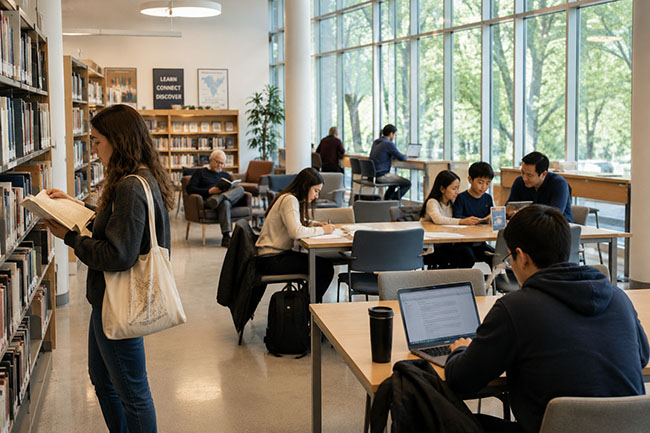
When people visit a public library in the United States for the first time, they are often surprised to see that many visitors are not there to read books. Some are updating their résumés on public computers, others are asking library staff for help using their smartphones. In the children’s section, librarians may be reading stories aloud, while another room hosts English classes or U.S. citizenship test preparation sessions.
If you have only thought of libraries as places to borrow books or study, American public libraries may seem quite different. While lending books remains their core function, they also provide internet access, job search assistance, digital literacy training, children’s educational programs, cultural events, and community information.
According to the American Library Association, most public libraries in the United States provide internet access, and many also assist residents with employment resources and online government services. Libraries not only provide information directly but also connect people with organizations that can help them further. They play an especially important role for people without reliable internet access, immigrants learning English, and job seekers.
It is important to note that there is no single nationwide public library system in the United States. Each city, county, and state operates its libraries independently. As a result, available services, library card eligibility, and free programs vary by location. The services described in this article are common, but readers should always check the website of their local library for the most accurate information.
Access a Wide Range of Resources with a Library Card
The first step to making the most of an American public library is getting a library card. Although some libraries use terms such as “Borrower Card” or “Membership Card,” the purpose is essentially the same. A library card provides access not only to printed books but also to e-books, audiobooks, movies, music, research databases, and online learning resources.
Most libraries issue free cards to residents of their city or county, as well as people who work or attend school in the area. Applicants usually need identification and proof of address. A driver’s license with a current address may be sufficient, while others may need utility bills, lease agreements, bank statements, or official mail.
Some libraries also offer temporary or paid cards for visitors or non-residents, although eligibility varies. Many libraries now allow online pre-registration before requiring applicants to visit in person for identity verification. Children’s library cards often require parental consent and may include restrictions on borrowing privileges or internet use.
1. Borrow Books, Magazines, E-books, and Audiobooks
The most familiar library service is borrowing books. Libraries offer novels, nonfiction, children’s books, cookbooks, travel guides, magazines, newspapers, graphic novels, large-print editions, and foreign-language materials. Libraries in areas with large Korean communities may even provide Korean books and newspapers.
If the book you want is unavailable at your local branch, you can usually place a hold and have it delivered from another branch within the same library system. If the entire system does not own the item, many libraries also participate in Interlibrary Loan (ILL), allowing patrons to borrow materials from other library systems or universities.
Digital borrowing has become one of the most valuable library services. Using your library card, you can borrow e-books and audiobooks through platforms such as Libby, Hoopla, or CloudLibrary, depending on your library’s subscriptions. These digital materials automatically return themselves when the loan period expires, eliminating overdue fines.
2. Free Wi-Fi, Public Computers, and Office Software
Nearly every American public library offers free Wi-Fi. Some provide open access, while others require users to log in with a library card. Many libraries even keep their Wi-Fi available outside the building after business hours so nearby residents can connect from parking lots or surrounding areas.
Libraries also provide public computers equipped with software for word processing, spreadsheets, presentations, and internet browsing. These computers are widely used for job applications, school assignments, online government forms, medical appointments, and email.
Printing, scanning, copying, and faxing are also commonly available. Some services are free, while others charge a small fee per page. Certain libraries even lend laptops, tablets, and portable Wi-Fi hotspots to eligible patrons.
3. Free Access to Research Databases and Online Learning
One of the greatest benefits of a library card is access to expensive online resources at no cost. Depending on the library, users may access newspapers, magazines, academic journals, genealogy databases, automotive repair manuals, business information, language learning platforms, and more.
Many libraries also subscribe to online learning platforms that offer courses in computer skills, coding, graphic design, business, languages, certification preparation, and professional development. Some even include streaming services for movies, documentaries, educational videos, and music.
Programs That Support Education, Employment, and Daily Life
Public library programs vary according to community needs. Large metropolitan libraries often employ specialists, while smaller libraries frequently partner with nonprofit organizations and volunteers. Seasonal programs also change throughout the year, with summer reading programs, tax assistance, homework help, and educational workshops offered at different times.
4. Digital Literacy and Technology Classes
Public libraries help bridge the digital divide by teaching practical technology skills. Courses may include computer basics, email, internet safety, document creation, smartphone use, cloud storage, and video conferencing.
Some libraries provide one-on-one technology assistance where visitors can receive help with installing apps or solving technical problems on their own devices. Larger libraries may also offer makerspaces equipped with 3D printers, recording studios, podcast equipment, and video editing tools.
5. Job Search Assistance
Libraries provide valuable support for job seekers. While they do not replace professional career counselors, they help patrons search job listings, create email accounts, prepare résumés, complete online applications, and print important documents.
Many larger libraries also organize résumé workshops, mock interviews, career counseling sessions, and workforce development programs. Entrepreneurs may find business planning workshops, market research databases, and small business resources.
6. English Classes and Citizenship Preparation
Libraries in immigrant communities often offer free ESL (English as a Second Language) classes and conversation groups. Programs range from beginner-level English to more advanced classes designed for employment or higher education.
Many libraries also provide study materials and workshops for applicants preparing for the U.S. citizenship examination. While librarians cannot offer legal immigration advice, they can direct visitors to official resources and qualified organizations.
7. Children’s Learning Programs
Families with young children often benefit greatly from library programs. Storytime sessions, songs, crafts, and educational activities help children develop early literacy skills while giving parents ideas for reading together at home.
Libraries also offer homework assistance, tutoring, teen programs, volunteer opportunities, and summer reading challenges that encourage children to continue reading during school vacations.
Cultural and Community Services
American public libraries serve as community centers as well as educational institutions. Many host concerts, lectures, author talks, book clubs, movie screenings, art exhibitions, gardening workshops, photography classes, and community discussions.
8. Free or Discounted Museum Passes
Some libraries partner with museums, zoos, science centers, and cultural institutions to provide free or discounted admission passes. Programs such as Discover & Go allow library cardholders to reserve passes online and enjoy local attractions at little or no cost.
9. Community Events and Hobby Programs
Libraries organize a wide variety of free activities for all ages, including writing groups, knitting clubs, chess clubs, cooking demonstrations, technology workshops, and educational seminars. These events help residents meet new people, build friendships, and stay connected with their communities.
10. Community Information and Public Services
Libraries often serve as a starting point for residents seeking assistance with housing, food programs, healthcare, taxes, legal aid, disaster relief, or government services. Rather than providing these services directly, libraries frequently connect patrons with qualified nonprofit organizations and government agencies.
During tax season, some libraries host free tax preparation programs staffed by certified volunteers. Others provide health screenings, legal clinics, or social service information sessions in partnership with local organizations.
Before You Visit
Before using your local public library, it is helpful to verify:
- Library card eligibility requirements.
- Branch hours and holiday schedules.
- Whether registration is required for programs.
- Borrowing policies, overdue rules, and replacement fees.
- Rules for borrowing high-value equipment such as laptops or Wi-Fi hotspots.
- Privacy practices when using public computers.
Conclusion
American public libraries are much more than places to borrow books. They provide free internet access, computers, digital resources, employment assistance, English classes, children’s educational programs, cultural activities, museum passes, and connections to valuable community services.
A single library card can unlock access to e-books, audiobooks, research databases, streaming media, online courses, and much more—all at no cost.
Because services vary by location, the best way to learn what is available is to visit your local library’s official website. Look for sections such as Get a Library Card, Digital Resources, Classes and Events, Computer Access, and Job Help.
Even if you have no intention of borrowing a book, your neighborhood public library may offer free resources and opportunities that can make everyday life easier, more affordable, and more connected.