
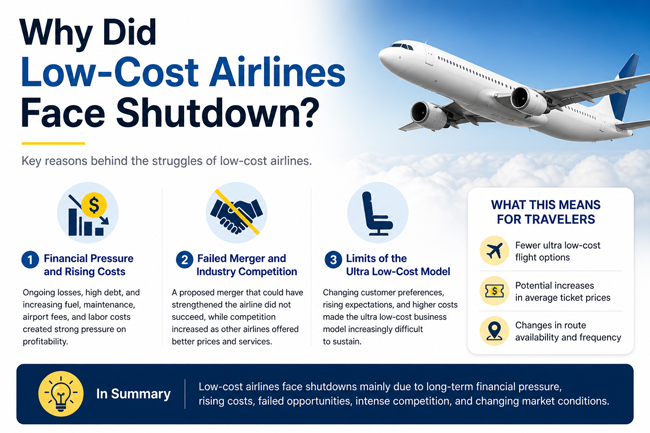
Why did Spirit Airlines shut down?
This question has been widely asked as travelers noticed changes in routes, pricing, and overall availability.
Rather than being caused by a single event, the situation reflects a combination of long-term financial pressure, industry-wide challenges, and shifting market conditions. Below is a clear and fact-based explanation.
What Happened to Spirit Airlines?
Spirit Airlines
was known as an ultra low-cost carrier in the United States.
Its business model focused on offering very low base fares, while charging additional fees for optional services such as baggage, seat selection, and onboard amenities. This approach made it possible for travelers to access cheaper tickets, especially for short-distance or flexible trips.
However, this model depends on maintaining a careful balance between low operating costs and consistent passenger demand. When that balance is disrupted, it becomes difficult to sustain operations over time.
As market conditions evolved, maintaining that balance became increasingly challenging.
Financial Pressure and Rising Costs
One of the most significant factors behind the shutdown was long-term financial strain.
Spirit Airlines had been dealing with:
- continued operating losses over multiple periods
- rising levels of debt
- increasing pressure on cash flow needed for daily operations
Airlines operate in a cost-sensitive environment. Even small increases in expenses can have a major impact on profitability, particularly for companies that rely on low fares.
At the same time, operating costs increased across the industry. These included:
- fuel costs, which are often volatile and difficult to predict
- aircraft maintenance and parts
- airport and regulatory fees
- labor and staffing expenses
Because Spirit Airlines focused on keeping fares as low as possible, it had limited flexibility to increase ticket prices. Raising prices could reduce demand, which is essential for a high-volume, low-margin model.
This created a situation where costs continued to rise while revenue remained constrained, making long-term sustainability more difficult.
Failed Merger and Industry Competition
To improve its financial position and strengthen its market presence, Spirit Airlines pursued a merger with another airline.
A successful merger could have provided:
- greater financial stability
- access to additional resources
- expanded route networks
- improved operational efficiency
However, the merger did not proceed. Without this strategic option, the company lost a major opportunity to restructure and stabilize its business.
At the same time, competition in the airline industry became more intense. Many airlines began offering competitive pricing while maintaining higher levels of service and reliability.
Travelers increasingly had access to alternatives that provided:
- fewer unexpected fees
- more consistent scheduling
- improved customer experience
As a result, some passengers shifted away from ultra low-cost carriers toward airlines that offered a more balanced combination of price and service.
This shift further reduced Spirit Airlines’ competitive advantage.
Limits of the Ultra Low-Cost Model
Spirit Airlines operated under an ultra low-cost carrier (ULCC) model, which depends on several key conditions:
- maintaining very low operating costs
- achieving high passenger volume
- sustaining strong demand for budget travel
When these conditions are stable, the model can be effective. However, when costs increase or demand patterns change, it becomes more difficult to maintain profitability.
In recent years, traveler preferences have gradually shifted. Many passengers began to place greater importance on:
- reliability and on-time performance
- overall travel convenience
- transparency in pricing
- flexibility in booking and changes
While low prices remain important, they are no longer the only deciding factor for many travelers.
This shift reduced the relative advantage of the ultra low-cost model and increased pressure on airlines that depend heavily on that approach.
Broader Industry and Economic Factors
In addition to company-specific challenges, broader industry and economic factors also played a role.
The airline industry is influenced by:
- global fuel price fluctuations
- economic conditions affecting travel demand
- regulatory decisions and market structure
- operational disruptions and supply chain issues
These external factors can amplify internal challenges. For an airline already operating under financial pressure, such conditions can accelerate the path toward shutdown.
What This Means for Travelers
The shutdown of Spirit Airlines may have several implications for travelers:
- fewer ultra low-cost flight options in certain markets
- potential increases in average ticket prices
- adjustments in route availability and frequency
- reduced competition on specific routes
Travelers who relied on budget carriers may need to plan more carefully, compare options, and adjust expectations regarding pricing and service.
Conclusion
Spirit Airlines did not shut down due to a single cause or isolated incident.
Instead, it was the result of multiple interconnected factors:
- long-term financial pressure
- rising operating costs
- unsuccessful strategic efforts such as a merger
- increasing competition in the airline industry
- evolving customer expectations
- broader economic and industry conditions
👉 In summary:
Spirit Airlines shut down because its business model became increasingly difficult to sustain under changing financial and market conditions.