
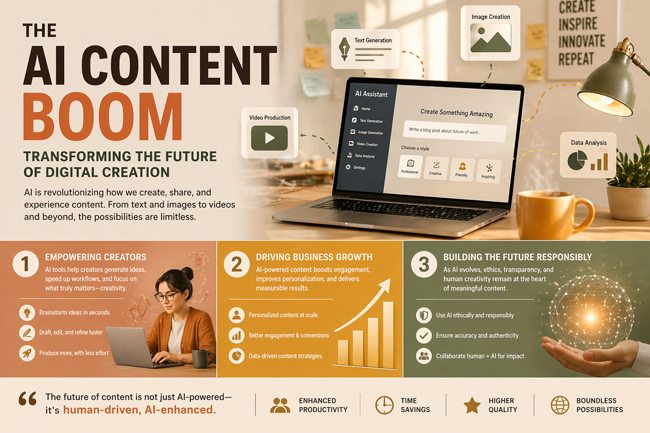
In recent years, the rapid advancement of artificial intelligence has significantly reshaped the digital landscape. Among the most notable developments is the AI content boom, a phenomenon that is transforming how content is created, distributed, and consumed. From automated writing tools to AI-generated images and videos, this trend is influencing industries worldwide. In this article, we will respectfully explore the rise of AI-generated content, its impact on creators and businesses, and what the future may hold.
1. Understanding the Rise of AI-Generated Content
The AI content boom refers to the widespread adoption of artificial intelligence technologies in the creation of digital content. Tools powered by machine learning and natural language processing can now generate articles, social media posts, images, and even videos with remarkable speed and accuracy.
One of the primary reasons for this rapid growth is efficiency. AI tools allow individuals and organizations to produce large volumes of content in a short period of time. This is especially valuable in today’s fast-paced digital environment, where content demand continues to increase.
Another key factor is accessibility. Previously, content creation required specialized skills such as writing, graphic design, or video editing. However, AI tools have lowered these barriers, enabling more people to participate in the digital economy.
Furthermore, businesses are increasingly integrating AI into their marketing strategies. Personalized content, automated customer communication, and data-driven storytelling have become essential components of modern digital engagement.
2. Opportunities and Challenges for Creators
While the AI content boom presents many opportunities, it also introduces new challenges that must be carefully considered. For content creators, AI can serve as a powerful assistant, helping to generate ideas, streamline workflows, and improve productivity.
However, there are concerns regarding originality and authenticity. As AI-generated content becomes more common, distinguishing between human-created and machine-generated work may become increasingly difficult. This raises important questions about trust, creativity, and intellectual ownership.
Additionally, there is growing discussion حول job displacement. Some fear that automation may reduce the demand for certain creative roles. At the same time, others argue that AI will create new opportunities by enabling creators to focus on higher-level thinking and strategy.
Another challenge is content saturation. With the ability to produce content at scale, the internet may become increasingly crowded, making it harder for individual voices to stand out. As a result, quality and uniqueness will become more important than ever.
3. The Future of AI Content and Digital Innovation
Looking ahead, the influence of AI on content creation is expected to continue expanding. Advances in generative AI will likely lead to even more sophisticated and personalized content experiences.
One promising direction is the integration of AI with human creativity. Rather than replacing creators, AI may serve as a collaborative tool that enhances creative expression. This partnership can lead to innovative forms of storytelling and communication.
Moreover, ethical considerations will play a crucial role in shaping the future of AI content. Transparency, responsible use, and clear guidelines will be essential to ensure that technology is used in a way that benefits society as a whole.
Governments and organizations may also introduce regulations to address concerns related to misinformation, copyright, and data privacy. These frameworks will help establish trust and accountability in the digital ecosystem.
Conclusion
In conclusion, the AI content boom represents a significant turning point in the evolution of digital media. While it offers remarkable opportunities for efficiency and innovation, it also requires careful consideration of its broader implications.
By embracing both technological advancement and ethical responsibility, individuals and organizations can navigate this transformation effectively. As we move forward, the balance between human creativity and artificial intelligence will define the next era of content creation.