
Understanding Google Shopping Campaigns
Google Shopping ads are a powerful tool for e-commerce businesses. Unlike traditional text ads, they display product images, titles, prices, and store names directly in search results. This visual appeal and immediate information can significantly increase click-through rates and drive qualified traffic to your online store. However, creating and managing effective Google Shopping campaigns requires a deep understanding of the platform, product feeds, bidding strategies, and ongoing optimization.
What are Google Shopping Ads?
Google Shopping ads, also known as Product Listing Ads (PLAs), appear in a dedicated “Shopping” tab on Google search results pages and alongside regular text ads. They showcase specific products, allowing potential customers to see exactly what you offer at a glance. This makes them ideal for driving impulse purchases and attracting shoppers who already have a specific product in mind.
The Importance of a Well-Optimized Product Feed
The foundation of any successful Google Shopping campaign is a well-structured and optimized product feed. This is a file (often a CSV, TSV, or XML) that contains detailed information about all your products, including:
-
Product Title: Crucial for matching search queries. Should be clear, descriptive, and include relevant keywords.
-
Product Description: Provides more detail and context.
-
Product Type: Helps Google categorize your products.
-
Brand: Essential for branded searches.
-
GTIN (Global Trade Item Number): Such as UPC, EAN, or ISBN. Crucial for accurate product identification.
-
Image Link: High-quality, clear images are vital for attracting clicks.
-
Price: Must be accurate and match your website’s pricing.
-
Link: Direct link to the product page on your website.
-
Availability: In stock, out of stock, or pre-order.
-
Shipping Information: Costs and delivery times.
An unoptimized or incomplete product feed can lead to disapprovals, poor ad performance, and wasted ad spend.
Why Traditional PPC Expertise Isn’t Enough
While general Pay-Per-Click (PPC) expertise is valuable, Google Shopping campaigns have unique complexities. They require specialized knowledge in:
-
Product Feed Management: Regularly updating and optimizing the feed to ensure accuracy and improve search visibility.
-
Campaign Structure: Organizing products into logical ad groups based on performance, category, or profit margin.
-
Bidding Strategies: Understanding how to bid effectively for different product types and customer intent.
-
Performance Analysis: Monitoring key metrics like click-through rate (CTR), conversion rate, cost per acquisition (CPA), and return on ad spend (ROAS).
-
Competitive Analysis: Understanding what your competitors are doing and how to differentiate your offerings.
This is where a specialized Google Shopping agency can make a significant difference.
The Role of a Google Shopping Agency
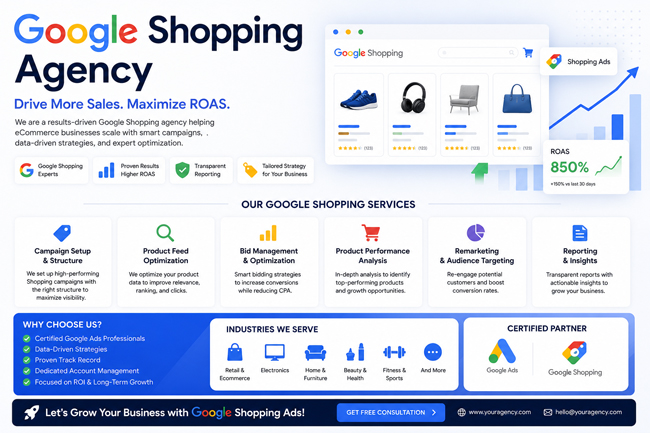
A Google Shopping agency is a team of experts dedicated to managing and optimizing Google Shopping campaigns for e-commerce businesses. They leverage their in-depth knowledge and experience to drive better results than you might achieve on your own.
Key Services Offered by a Google Shopping Agency
Reputable agencies offer a comprehensive suite of services designed to maximize your campaign’s effectiveness:
-
Product Feed Optimization:
-
Data Audit: Analyzing your existing product feed for errors, missing information, and areas for improvement.
-
Title & Description Enhancement: Rewriting titles and descriptions to include relevant keywords and improve searchability.
-
Attribute Management: Ensuring all necessary attributes are present and accurately populated.
-
Image Optimization: Advising on image quality and format.
-
Regular Updates: Implementing automated or manual processes for keeping the feed current.
-
Campaign Setup & Management:
-
Account Structure: Building a logical and efficient campaign structure within Google Ads.
-
Product Grouping: Segmenting products into custom groups for tailored bidding and targeting.
-
Bidding Strategy Development: Implementing and managing appropriate bidding strategies (e.g., Target ROAS, Maximize Conversions) based on your goals.
-
Budget Allocation: Distributing your budget effectively across different product groups and campaigns.
-
Negative Keyword Implementation: Preventing your ads from showing for irrelevant searches.
-
Performance Monitoring & Analysis:
-
Regular Reporting: Providing detailed reports on campaign performance, key metrics, and insights.
-
Data Analysis: Deep diving into performance data to identify trends, opportunities, and areas for improvement.
-
A/B Testing: Experimenting with different ad creatives, bidding strategies, and targeting options.
-
Strategic Consulting:
-
Goal Setting: Helping you define clear, measurable objectives for your campaigns.
-
Competitive Benchmarking: Analyzing competitor strategies and identifying opportunities to gain an edge.
-
Cross-Channel Integration: Advising on how Google Shopping can integrate with other marketing channels.
-
Forecasting & Planning: Providing insights into future performance and helping with strategic planning.
-
Advanced Tactics:
-
Performance Max (PMax) Campaigns: Expertise in setting up and optimizing PMax campaigns, which leverage Google’s AI across multiple channels, including Shopping.
-
Remarketing: Implementing strategies to re-engage users who have previously interacted with your products or website.
-
Dynamic Remarketing: Showing personalized product ads to users based on their past browsing behavior.
Benefits of Partnering with an Agency
Engaging a Google Shopping agency offers numerous advantages:
-
Increased Sales & Revenue: Optimized campaigns lead to more clicks, higher conversion rates, and ultimately, more sales.
-
Improved Return on Ad Spend (ROAS): Agencies focus on maximizing the return from every dollar spent on advertising.
-
Reduced Cost Per Acquisition (CPA): Efficient targeting and optimization help lower the cost of acquiring each new customer.
-
Time Savings: Offload the complex and time-consuming task of campaign management to experts, freeing up your internal resources.
-
Access to Expertise: Benefit from the knowledge and experience of specialists who stay current with platform changes and best practices.
-
Data-Driven Decisions: Agencies rely on data analytics to make informed decisions and continuously refine strategies.
-
Competitive Advantage: Stay ahead of competitors with sophisticated campaign management and strategic insights.
-
Scalability: Agencies can help you scale your campaigns as your business grows.
Choosing the Right Google Shopping Agency
Selecting the right agency is crucial for success. Here’s what to consider:
Factors to Evaluate
-
Experience & Specialization:
-
Proven Track Record: Look for agencies with a history of success specifically in Google Shopping. Ask for case studies and client testimonials.
-
E-commerce Focus: Ensure the agency understands the nuances of e-commerce and direct-to-consumer (DTC) sales.
-
Platform Expertise: Do they have certified Google Ads professionals on staff?
-
Services Offered:
-
Comprehensive Solutions: Do they offer end-to-end services from feed management to advanced strategy?
-
Customization: Can they tailor their services to your specific business needs and goals?
-
Communication & Reporting:
-
Transparency: How often will you receive reports, and what will they include?
-
Communication Style: Do they have a dedicated account manager? How accessible are they?
-
Clarity: Are their reports easy to understand and actionable?
-
Pricing & Contract Terms:
-
Fee Structure: Agencies typically charge a percentage of ad spend, a fixed monthly fee, or a hybrid model. Understand what works best for your budget.
-
Contract Length: Are you locked into a long-term contract, or is there flexibility?
-
Value Proposition: Does the potential ROI justify the agency’s fees?
-
Client Testimonials & Reviews:
-
Reputation: Check online reviews and ask for references from current or past clients.
Questions to Ask Potential Agencies
-
What is your experience with businesses in my industry/niche?
-
Can you share case studies of successful Google Shopping campaigns you’ve managed?
-
What is your process for product feed optimization?
-
How do you approach campaign structure and bidding strategies?
-
What reporting frequency and format can I expect?
-
Who will be my main point of contact?
-
What are your pricing models?
-
What are the typical results clients see within the first 3-6 months?
-
How do you stay updated on Google Ads platform changes?
Costs Associated with a Google Shopping Agency
The cost of hiring a Google Shopping agency can vary significantly based on several factors:
Common Pricing Models
-
Percentage of Ad Spend: This is the most common model, where the agency charges a percentage (typically 10-20%) of your total monthly ad budget. For example, if you spend $10,000 per month on Google Shopping ads and the agency charges 15%, their fee would be $1,500.
-
Fixed Monthly Fee: Some agencies offer a flat monthly fee for a defined set of services. This provides predictability but might not scale well with ad spend changes.
-
Performance-Based: Less common, but some agencies might tie a portion of their fee to achieving specific performance metrics (e.g., a bonus for hitting a certain ROAS target).
-
Hybrid Model: A combination of the above, such as a lower percentage of ad spend plus a base fee.
Factors Influencing Cost
-
Ad Spend Volume: Higher ad spend often means higher agency fees if using a percentage model, but sometimes agencies offer tiered discounts for larger budgets.
-
Scope of Services: Agencies offering more comprehensive services (e.g., full feed management, creative services, advanced analytics) will naturally cost more.
-
Agency Size & Reputation: Larger, more established agencies with a strong reputation often command higher fees.
-
Complexity of Your Business: Businesses with large product catalogs, multiple regions, or complex pricing structures might require more specialized management, leading to higher costs.
-
Geographic Location: Agencies in high-cost-of-living areas might have higher overheads.
What to Expect in Terms of Investment
-
Small Businesses: Might start with a monthly retainer of $500 – $2,000, or a percentage of ad spend on a smaller budget.
-
Medium-Sized Businesses: Could range from $2,000 – $10,000+ per month, depending on ad spend and service depth.
-
Large Enterprises: Fees can be significantly higher, often involving custom packages and dedicated teams.
Important Note: Always ensure the agency’s fees are transparent and clearly outlined in a contract. Focus on the potential return on investment (ROI) rather than just the cost. A good agency should be able to demonstrate how their services will generate more revenue than their fees.
Maximizing Your Google Shopping ROI
A Google Shopping agency’s primary goal is to maximize your Return on Investment (ROAS). They achieve this through a combination of strategic planning, meticulous execution, and continuous optimization.
Key Strategies for ROI Maximization
-
Data-Driven Optimization:
-
Performance Segmentation: Continuously analyzing which products, categories, and campaigns are performing best and allocating budget accordingly.
-
Bid Adjustments: Dynamically adjusting bids based on product profitability, seasonality, device type, location, and audience.
-
Identifying Underperformers: Quickly identifying products or campaigns that are not meeting expectations and either optimizing them or pausing them to reallocate budget.
-
Advanced Feed Management:
-
Strategic Titles & Descriptions: Going beyond basic keywords to craft compelling copy that resonates with search intent.
-
Leveraging Custom Labels: Using custom labels to segment products for more granular bidding and reporting (e.g., by profit margin, seasonality, best-sellers).
-
Ensuring Data Accuracy: Preventing wasted ad spend due to incorrect pricing, availability, or shipping information.
-
Leveraging Google Ads Features:
-
Performance Max (PMax): Utilizing PMax campaigns for broader reach across Google’s network, powered by AI, while ensuring Shopping remains a strong component.
-
Audience Targeting: Layering relevant audiences (e.g., in-market, affinity, remarketing lists) onto Shopping campaigns to reach more qualified buyers.
-
Negative Keywords: Proactively adding negative keywords to filter out irrelevant traffic and improve ad relevance.
-
Competitive Analysis:
-
Monitoring Competitor Ads: Understanding competitor pricing, promotions, and ad messaging.
-
Identifying Gaps: Finding opportunities where competitors are not effectively serving certain customer needs or product types.
-
Conversion Rate Optimization (CRO) Collaboration:
-
While an agency manages ads, they often collaborate with your web team to ensure the landing page experience is optimized for conversions. This includes fast loading times, clear calls-to-action, and a smooth checkout process.
Common Mistakes to Avoid (and How an Agency Helps)
-
Poorly Optimized Product Feed: Leads to disapprovals and missed sales opportunities. Agency Solution: Expert feed audits and continuous optimization.
-
Generic Campaign Structure: Not segmenting products effectively, leading to inefficient bidding. Agency Solution: Strategic product grouping and custom segmentation.
-
Ignoring Negative Keywords: Wasting budget on irrelevant searches. Agency Solution: Proactive and ongoing negative keyword management.
-
Static Bidding Strategies: Not adapting bids to changing market conditions or product performance. Agency Solution: Dynamic bidding strategies and continuous adjustments.
-
Lack of Performance Tracking: Not understanding what’s working and what’s not. Agency Solution: Comprehensive, data-driven reporting and analysis.
-
Over-Reliance on Automation: Letting automated bidding run without strategic oversight. Agency Solution: Balancing automation with expert human strategy and oversight.
Frequently Asked Questions (FAQ)
Q1: How long does it take to see results from a Google Shopping agency?
A: Results can vary depending on your industry, competition, and current campaign performance. However, most agencies aim to show noticeable improvements within the first 1-3 months. Significant growth and optimization often take 3-6 months as the agency refines strategies based on data.
Q2: Can a Google Shopping agency help with international expansion?
A: Yes, many agencies have experience managing multi-country and multi-language Google Shopping campaigns. They can help with currency conversion, localization, and understanding regional market nuances.
Q3: What if I have a very large product catalog (thousands of products)?
A: Agencies specializing in Google Shopping are well-equipped to handle large product catalogs. They utilize advanced feed management tools and strategies to efficiently manage and optimize thousands of SKUs.
Q4: Do I need to provide my own product images, or do agencies create them?
A: Typically, you will need to provide high-quality product images. However, an agency can advise on image specifications and best practices to ensure they perform well in Shopping ads. Some agencies might offer additional creative services, but this is often an add-on.
Q5: How is a Google Shopping agency different from a general digital marketing agency?
A: While a general agency might offer Google Shopping as part of a broader service package, a specialized Google Shopping agency focuses exclusively on this channel. This deep specialization allows them to possess more in-depth knowledge, advanced tools, and refined strategies specifically for product listing ads and e-commerce performance.
Conclusion: Investing in Expertise for E-commerce Growth
Google Shopping campaigns offer immense potential for e-commerce businesses, but mastering their intricacies can be challenging. Partnering with a specialized Google Shopping agency transforms this challenge into an opportunity. By leveraging their expertise in product feed optimization, campaign management, data analysis, and strategic bidding, you can significantly boost your sales, improve your ROAS, and gain a competitive edge.
When choosing an agency, prioritize experience, transparency, and a clear understanding of your business goals. The right partner will not just manage your campaigns but will act as an extension of your team, dedicated to driving sustainable growth and maximizing your return on investment in the dynamic world of online retail.
Next Steps to Grow Your Sales:
-
Audit Your Current Feed: Before contacting agencies, review your existing product feed for completeness and accuracy.
-
Define Your Goals: Clearly articulate what you want to achieve (e.g., increase ROAS by 20%, grow sales by 15%).
-
Research & Shortlist Agencies: Identify 3-5 agencies that specialize in Google Shopping and fit your business needs.
-
Schedule Consultations: Have in-depth conversations to assess their expertise, communication style, and proposed strategies.
-
Review Proposals Carefully: Compare offerings, pricing, and expected outcomes before making a decision.
Investing in a Google Shopping agency is an investment in your e-commerce future. Choose wisely, and unlock the full potential of Google’s powerful advertising platform.