
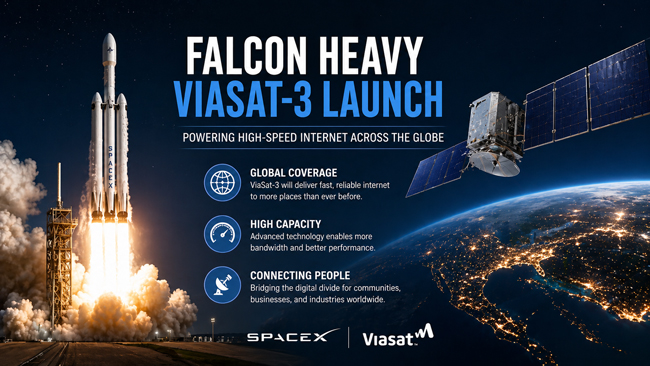
The recent Falcon Heavy ViaSat-3 launch has captured global attention as one of the most significant developments in modern space and communications technology, marking another milestone for SpaceX and its heavy-lift rocket capabilities. As demand for high-speed internet continues to grow worldwide—especially in remote and underserved regions—satellite-based solutions are becoming increasingly critical to bridging the digital divide. The launch of ViaSat-3 is not just a routine space mission; it represents a strategic step toward building a more connected world where access to reliable internet is no longer limited by geography. With advanced satellite technology and one of the most powerful rockets currently in operation, this mission highlights how space infrastructure is rapidly becoming an essential part of global communication networks.
What Is Falcon Heavy and Why It Matters
The Falcon Heavy is currently one of the most powerful operational rockets in the world, designed to carry heavy payloads into orbit with remarkable efficiency and reusability, which significantly reduces the cost of space missions compared to traditional launch systems. Built by SpaceX, Falcon Heavy uses three Falcon 9 boosters combined into a single launch vehicle, enabling it to deliver satellites, scientific instruments, and even future human missions deeper into space. Its importance lies not only in its raw power but also in its role in transforming the economics of space travel, making large-scale satellite deployment more feasible than ever before. In the context of the ViaSat-3 mission, Falcon Heavy provides the necessary lift capacity to place a high-performance communications satellite into geostationary orbit, where it can maintain a fixed position relative to the Earth and deliver consistent coverage across vast geographic regions.
What Is ViaSat-3 and Its Role in Global Internet Expansion
The ViaSat-3 is a next-generation communications satellite designed to deliver high-capacity broadband internet across large portions of the globe, including regions that traditionally lack reliable connectivity. Unlike earlier satellites with limited bandwidth and coverage, ViaSat-3 is part of a new class of high-throughput satellites that use advanced technology to dramatically increase data capacity, enabling faster speeds and more stable connections for users on land, at sea, and in the air. This makes it particularly valuable for industries such as aviation, maritime operations, and rural infrastructure, where conventional ground-based networks are difficult or expensive to deploy. By expanding access to high-speed internet, ViaSat-3 plays a crucial role in supporting economic development, education, and communication in areas that have historically been underserved.
How This Launch Impacts the Future of Connectivity
The Falcon Heavy ViaSat-3 launch represents more than just a technological achievement; it signals a broader shift toward a more space-driven approach to global connectivity, where satellite networks complement and extend traditional infrastructure to create a more resilient and inclusive digital ecosystem. As more companies invest in satellite constellations and high-capacity systems, competition and innovation are likely to drive improvements in both performance and affordability, making internet access more widely available. This also has implications for global communication resilience, as satellite systems can provide backup connectivity during natural disasters or infrastructure failures on the ground. In the long term, missions like this one contribute to a future where connectivity is treated as a fundamental utility, similar to electricity or water, and where space technology plays a central role in supporting everyday life.
Conclusion: A Step Toward a More Connected World
The Falcon Heavy ViaSat-3 launch stands as a powerful example of how advancements in space technology are directly shaping the future of global communication, demonstrating that the boundaries between aerospace innovation and everyday digital life are becoming increasingly intertwined. By combining one of the world’s most capable rockets with a next-generation communications satellite, this mission highlights the growing importance of space infrastructure in addressing real-world challenges such as connectivity gaps and digital inequality. As technology continues to evolve, launches like this will likely become more frequent and more impactful, reinforcing the idea that access to information and communication is not just a convenience but a necessity in the modern world. Ultimately, the success of the ViaSat-3 mission reflects a broader vision of a fully connected planet, where distance and location no longer determine access to opportunity.